REVIEW · SORRENTO
Private Pompeii & Herculaneum Tour from Sorrento
Book on Viator →Operated by IAMME IA! - Gray Line Amalfi Coast · Bookable on Viator
Pompeii and Herculaneum, in one organized day. This private tour is built for people who want major ruins without wasting hours stuck in lines. You’ll get time-saving transportation from Sorrento, then a guide who connects the big eruption story to daily Roman life.
I especially like how the pacing respects how huge both sites are. You receive a focused 2-hour guided visit in Pompeii and a 2-hour guided visit in Herculaneum, plus time to wander afterward.
The main drawback to weigh is the price: at $769.43 per person, this is a premium option. If you’re traveling solo or on a tight budget, you may want to price-check alternatives that trade comfort and guidance for lower cost.
In This Review
- Key points at a glance
- A Smart Day Plan From Sorrento
- Pickup and Timing: What the 8 Hours Feels Like
- Entering Pompeii’s Ashed Streets With a Private Guide
- Pompeii Stops You’ll Actually Notice (Forum, Shops, Baths, and More)
- The practical trade-off in Pompeii
- Herculaneum: Mud and Lava, With Less Distance to the Past
- Herculaneum Stops That Make the Ruins Feel Real
- The practical trade-off in Herculaneum
- Skip-the-Line Tickets and Your Guide’s Real Value
- Lunch Breaks and Staying Comfortable in Summer Heat
- Price and Value: What $769.43 per Person Buys
- Who This Tour Suits Best
- Should You Book This Private Pompeii & Herculaneum Tour From Sorrento?
- FAQ
- How long is the Private Pompeii & Herculaneum Tour from Sorrento?
- Is pickup from Sorrento included?
- What is the tour language?
- Is this a private tour?
- Are admission tickets included?
- Does the tour include skip-the-line tickets?
- What about lunch?
- What time will I be back in Sorrento?
- How do I get my tickets?
- Is there free cancellation?
Key points at a glance
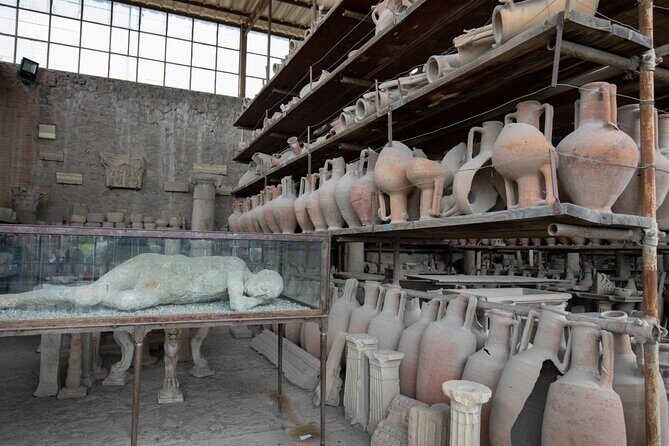
- Skip-the-line entry in Pompeii and Herculaneum so your day starts when it should
- Hotel-area pickup and return mean less logistics stress in Sorrento
- English private guide time with built-in explanations of what you’re seeing
- Two cities, one day: Pompeii (2 hours) plus Herculaneum (2 hours)
- Small, thoughtful stops across forums, baths, homes, and daily-life spaces
- Hot-weather comfort matters: you’ll walk in exposed outdoor ruins
A Smart Day Plan From Sorrento
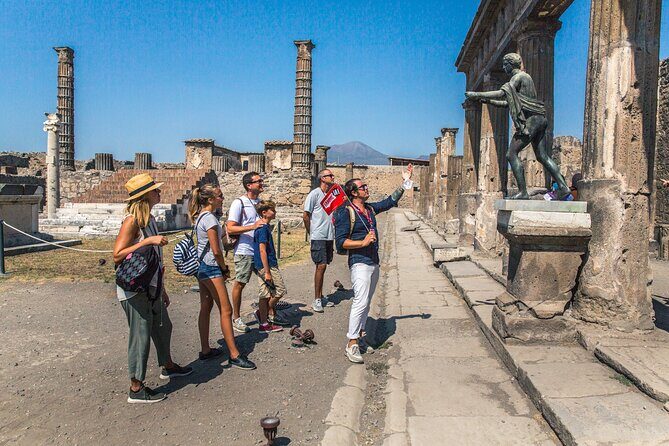
This tour is designed for a very specific kind of traveler: you want the big-ticket places, but you don’t want to spend your vacation figuring out transportation, ticket timing, and where to go first. From your pickup point in central Sorrento, you’re driven inland to Pompeii, then moved again to Herculaneum, with return transfer back to Sorrento later in the afternoon.
The schedule is built around two guided blocks. In Pompeii, you get enough time to understand the layout and hit key monuments without trying to cover everything. Then you shift to Herculaneum, where the ruins feel smaller but often more intimate because they’re so well preserved.
You can also read our reviews of more private tours in Sorrento


Pickup and Timing: What the 8 Hours Feels Like
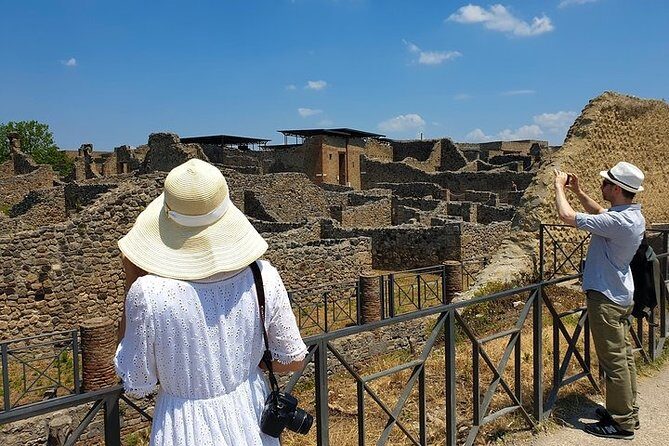
You meet at your hotel or a central location in Sorrento at an agreed time, using a private air-conditioned vehicle. The tour starts from the Sorrento area (one listed meeting point is Piazza Torquato Tasso, 16), and you return to the meeting point at the end.
The day runs about 8 hours total, with the sightseeing concentrated into two guided segments: 2 hours in Pompeii and 2 hours in Herculaneum. Between them, you’ll have free time for lunch on your own (not included), and you’ll likely want to use that break to cool down and recharge.
Practical tip: start your day with sunscreen and comfortable shoes. Even with air-conditioned driving, you’ll spend serious time walking on uneven archaeological paths and sun-exposed stone.
Entering Pompeii’s Ashed Streets With a Private Guide
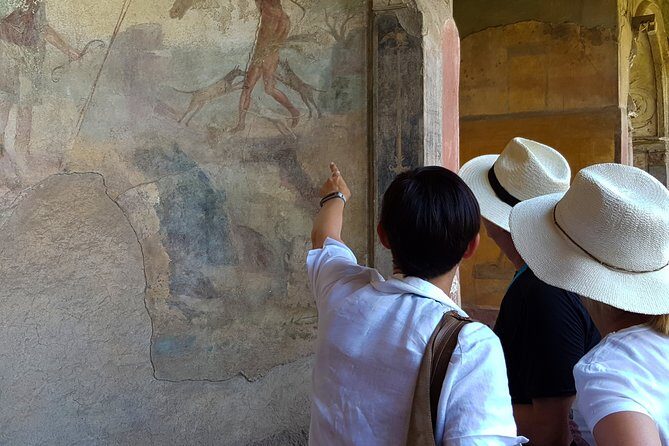
Pompeii is enormous. That’s the problem with self-guided visits: you can end up wandering in the right place but still missing the story. With a guide, you start to recognize how the city worked—where people gathered for business and worship, where they bathed, and where daily commerce lived.
Your Pompeii visit is centered on the famous AD 79 eruption of Mount Vesuvius—the disaster that buried the town under volcanic ash and pumice. But the best part of Pompeii isn’t just the tragedy. It’s how intact so many everyday spaces are, which is exactly what a good guide helps you notice.
I also like that the tour uses the entrance strategically. With skip-the-line tickets included, you avoid the classic frustration of waiting while other visitors move inside.
Pompeii Stops You’ll Actually Notice (Forum, Shops, Baths, and More)
Instead of treating Pompeii like a checklist, the tour threads you through major “daily life” zones. You begin near the core of civic and commercial activity and work your way through public buildings, street life, and elite homes.
Here are the high-value moments you’ll spend time on:
The Forum (Foro de Pompeya) + Temple Area
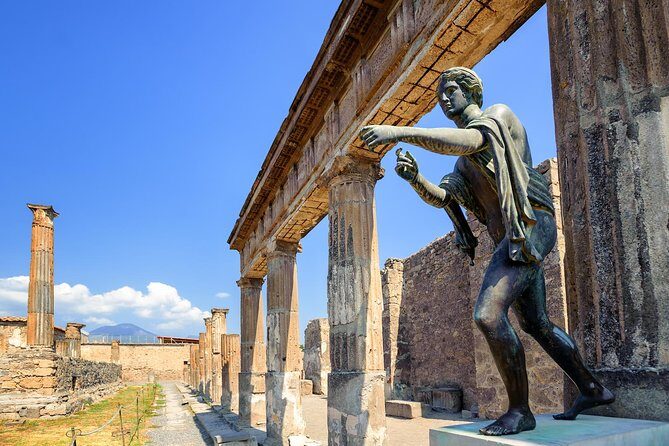
The Forum is the city’s nerve center: administration, justice, business, and trade. From there, you’ll spend time by the Temple of Jupiter (Tempio di Giove Capitolino), which ties architecture to the colony’s identity—especially the role of Jupiter, Juno, and Minerva as cult statues placed so they were visible from the Forum square, with Vesuvius rising in the background.
Macellum (Market) + the “how people ate and shopped” story
The Macellum wasn’t just a place to buy food. It functioned with temple space and meeting areas nearby, and it’s built to show how worship and commerce were intertwined. Even if you don’t read every detail on-site, the arrangement makes the daily routine make sense.
Via dell’Abbondanza (Main shopping street)
Walking Via dell’Abbondanza gives you a real sense of scale. This was Pompeii’s main commercial artery, stretching from the Forum to the Sarno Gate. You’ll get a guided lens on shopfronts, workshops, and the kind of street-level “soundtrack” you normally never experience in a ruined city—things like raised stepping stones and graffiti-like electoral marks on building surfaces.
Stabian Baths (Terme Stabiane)
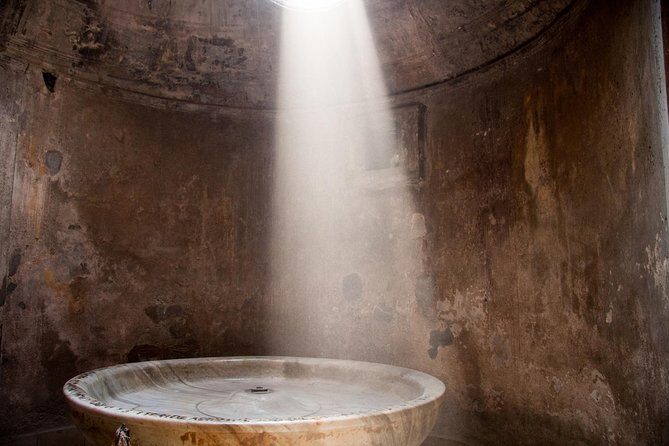
Roman bathing is more than hygiene; it’s social structure. The Stabian Baths are among the oldest and largest bathing complexes in Pompeii, with features like an underfloor heating system (hypocaust) and distinct spaces for men and women. This stop also helps you understand the engineering behind daily life—because the ruins show how planned comfort worked, not just what survived.
Lupanar (the brothel with wall paintings)
The Lupanar is one of Pompeii’s most famous and most talked-about sites, largely because of the erotic wall paintings. The tour gives context around how the business was organized and who served there, including the fact that many prostitutes were described as Greek and Oriental slaves. If you’d rather avoid that subject, you can still treat this stop as a lens into Roman attitudes and social reality—not just shock value.
Casa del Fauno (House of the Faun)
This is where you see Pompeii’s elite domestic life. The House of the Faun was built during the 2nd century BC and is one of the largest and most impressive private residences. It’s a good reminder that Pompeii wasn’t only a place of public plazas and temples—wealthy households shaped art, status, and home design.
Teatro Grande (Theater)
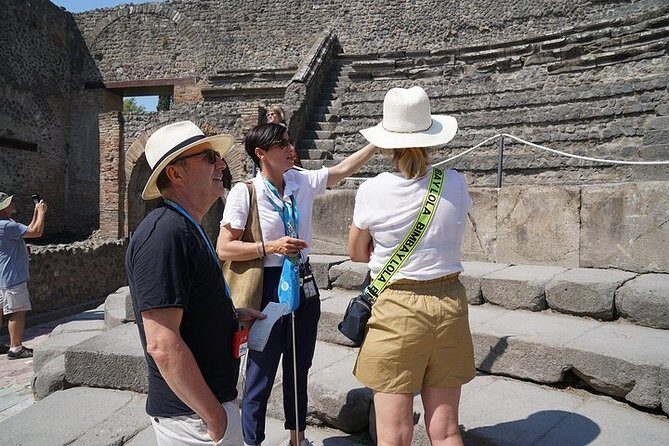
The Teatro Grande was designed for about 5,000 spectators, carved into a hillside. It’s a clear example of Roman performance culture, built for comedies, tragedies, and pantomimes, with the Roman elite and ordinary citizens sharing the same entertainment ecosystem.
Basilica (Forum business and justice)
Finally, you’ll see the Basilica, described as the most sumptuous building in the Forum area and used for business and administration of justice. It’s a key anchor point: without this, the Forum can feel like “temples plus columns.” With it, you get a clearer picture of civic control and economic life.
The practical trade-off in Pompeii
You’re seeing a lot, but you’re not seeing everything. With only about 2 hours guided time, the tour wisely focuses on major spaces that explain the city. If you prefer to linger in one spot for an hour, you’ll want to plan extra time (or a second visit). For most people, though, this structure saves you from getting lost.
- Sorrento Farm and Food Experience including Olive Oil, Limoncello, Wine tasting
★ 5.0 · 2,524 reviews





Herculaneum: Mud and Lava, With Less Distance to the Past

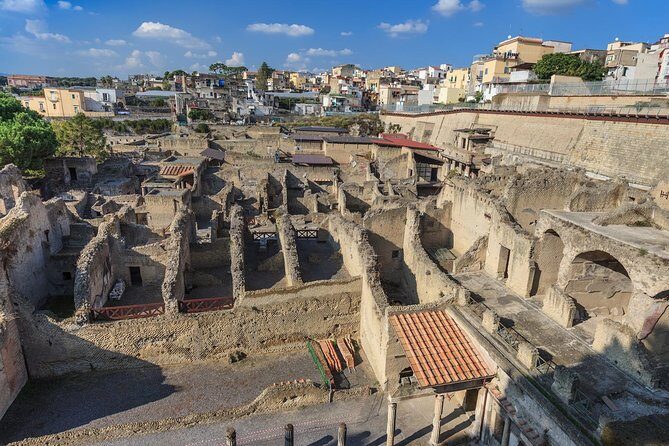
After Pompeii, you head to Herculaneum, another town buried in AD 79. The big difference is how it was preserved: many believe Herculaneum’s ruins are better preserved than Pompeii because the town was encased in mud and lava instead of only ash and pumice.
That preservation changes the feeling. Pompeii can be huge and wide-open; Herculaneum can feel more like you’re stepping into rooms that still have shape and function. You’ll get a guided hour-long tour through the ruins, plus time to explore on your own.
And yes, the Vesuvius story continues here too, but it lands differently—less “mystery of loss,” more “how daily spaces looked right up until the end.”
Herculaneum Stops That Make the Ruins Feel Real
Even within an efficient schedule, Herculaneum has specific places that help you understand how people lived and how the disaster affected them.
Casa dei Cervi (house with murals and seaside setting)
The Casa dei Cervi is described as a noble family house that before the volcanic mud slide had a seafront address. You’ll see how the villa was organized around a central courtyard, and you’ll get a sense of what “home art” looked like—murals and still-life paintings.
College of the Augustales (cult and headquarters idea)
This building is linked to the cult of Emperor Augustus, with a possible connection to the Collegium Augustalium and possibly local civic administration. In other words: it’s a window into political and religious identity at the local level.
House of the Skeleton
This stop is named after the discovery of human remains found in a second-floor room. The context is grim, but it’s also why Herculaneum can feel so immediate: some people shut themselves in homes and died there, likely from suffocation or extreme gases.
Central Thermae (public baths)
The Central Thermae show how baths were a public system. The tour explains that there were relatively few private baths, and that public bathing buildings were divided into women’s and men’s sections, each with cold, tepid, and hot bath rooms.
Partem Domus lignea (wooden door and client waiting space)
The Partem Domus Lignea, also known via the Casa del Tramezzo di Legno, is tied to a folding wooden door discovered there. It also highlights a “people waiting to be received” element—benches where clientes waited before entering the host’s space.
Salone della Barca di Ercolano (the recovered ancient boat)
This is the kind of Herculaneum detail you don’t forget. After the eruption, people fled toward the beach, but waves, sand, and lava destroyed the port area. The recovered wooden boat was preserved with resinous material and returned to its proper position so you can admire it.
The practical trade-off in Herculaneum
Herculaneum has a lot of small, specific details that reward slowing down. But because this is a timed day trip, you’re guided through key areas and then given some freedom to explore at leisure. If you’re the type who reads every panel, you may still want to extend your visit somehow—either by returning later or by choosing a longer on-site tour.
Skip-the-Line Tickets and Your Guide’s Real Value
The tour includes skip-the-line entrance tickets for both Pompeii and Herculaneum. That sounds like a small perk, but it’s a big deal on a day trip from Sorrento, where time is your most limited resource.
More importantly, a guide doesn’t just point at ruins. They connect what you’re seeing to human behavior: where people met to conduct business, where they worshipped, how bathing worked, and how wealth showed up in homes and theaters. This is why visitors often mention guides by name. For example, I’ve seen standout comments tied to guides like Connie, Ugo (Hugo), Carmela, and Nella—the kind of people who can answer questions and keep the day coherent even when the sites are overwhelming.
If you want one souvenir from this tour, it’s not a photo. It’s understanding. Pompeii and Herculaneum stop being ruins-on-a-map and start feeling like places with schedules, habits, and social rules.
Lunch Breaks and Staying Comfortable in Summer Heat
Lunch is on you here—free time between the two sites at a convenient restaurant. That matters because it keeps the tour flexible, and it also gives you a real chance to cool off and refuel without feeling like you’re missing museum time.
The tour itself recommends sunscreen and comfortable shoes since the weather can be very hot in summer. I’ll add one more practical point: bring a small bottle for water. One of the feedback themes I’ve seen is that guests wished they’d been provided water during the day.
You’ll also walk in and around archaeological surfaces where shade is limited. Plan your pace with that in mind, especially if you’re sensitive to heat.
Price and Value: What $769.43 per Person Buys
At $769.43 per person, this isn’t a budget day. It’s priced like a premium logistics solution: private vehicle, private guiding time, admission handling, and skip-the-line entry in two separate archaeological parks.
So what are you really paying for?
- Time savings from Sorrento plus skip-the-line access
- Guide time in both sites so you don’t get lost in the scale
- A structured route that hits the most meaningful spaces for understanding Roman daily life
- Private transportation in an air-conditioned vehicle, which is not nothing in heat
If you’re traveling as a couple or a small group and you want one day that feels “done right,” the price starts making more sense. If you’re a solo traveler who’s comfortable navigating on your own, you might be able to find less expensive options—but you’ll trade away some of the guidance and convenience that make this kind of day trip actually work smoothly.
Who This Tour Suits Best
This tour makes the most sense if you:
- Want Pompeii and Herculaneum together in one day without planning the details
- Prefer a guided flow over wandering
- Value skip-the-line tickets and private pickup/drop-off
- Are okay paying a premium for a smoother day
It may be less ideal if you:
- Want a slow, self-paced deep study at only one site
- Have a very tight budget and would rather DIY
It’s also a strong choice for families and multi-generational groups, as long as everyone can handle the walking and heat. The day is paced with stops and guided explanation, not nonstop marching.
Should You Book This Private Pompeii & Herculaneum Tour From Sorrento?
If your goal is to see Pompeii and Herculaneum with minimal hassle and maximum understanding, I think this tour is an easy yes. The combination of hotel-area pickup, private transportation, skip-the-line access, and a guide-led route through major public spaces and homes is exactly how you avoid the common day-trip mistakes: wasted time, random wandering, and missing the story.
The only reason I’d hesitate is the price. If $769.43 per person feels too steep, you might look for a shared group option. But if you want a focused, guide-driven day that respects the scale of both UNESCO sites, this is the kind of planning you’ll thank yourself for later—especially once you’re standing in Pompeii’s Forum or in Herculaneum’s preserved room-and-street world.
FAQ
How long is the Private Pompeii & Herculaneum Tour from Sorrento?
The tour lasts about 8 hours.
Is pickup from Sorrento included?
Yes. Pickup is offered from your hotel or a central location in the Sorrento area.
What is the tour language?
The tour is offered in English.
Is this a private tour?
Yes. It’s listed as private, and only your group participates.
Are admission tickets included?
Yes. Admission tickets are included for both Pompeii and Herculaneum stops.
Does the tour include skip-the-line tickets?
Yes. Skip-the-line entrance tickets in Pompeii and Herculaneum are included.
What about lunch?
Lunch is not included. You’ll have free time for lunch between the Pompeii and Herculaneum parts.
What time will I be back in Sorrento?
Return transfer is around 4pm to 5pm.
How do I get my tickets?
The tour includes a mobile ticket.
Is there free cancellation?
Yes. Free cancellation is allowed up to 24 hours in advance for a full refund.


More Private Tours in Sorrento



More Tours in Sorrento


More Tour Reviews in Sorrento
- Sorrento Farm and Food Experience including Olive Oil, Limoncello, Wine tasting
★ 5.0 · 2,524 reviews