REVIEW · SORRENTO
Vesuvius,Herculaneum,Pompeii from Naples or Sorrento
Book on Viator →Operated by Mondo Guide Srl · Bookable on Viator
One volcano, two ancient cities, one full-day plan. This tour strings together a Vesuvius crater hike plus two of the best-preserved Roman sites around Naples. I especially like how you go beyond photos with a crater look, not just a bus stop.
A second big win is small-group guiding at Pompeii and Herculaneum, which makes the walking feel less like a scavenger hunt and more like a guided story. The main drawback to watch: you must buy the site tickets yourself (and the Vesuvius ticket is non-changeable and non-refundable).
In This Review
- Key things I’d mark on your must-do list
- Why this Vesuvius–Pompeii–Herculaneum day works from Sorrento
- The Vesuvius National Park stop: drive up, then climb for the views
- What you’ll actually get from the crater look
- Pompeii Archaeological Park: streets, buildings, and the feeling of time travel
- Herculaneum: smaller than Pompeii, and unusually intact
- How the guiding works (and why it matters in ruins)
- Tickets and entry fees: the part that needs your attention
- Price and value: is € and time ratio worth it?
- Time management: what the day feels like from start to finish
- What to bring for comfort (and a smoother hike)
- Who this tour fits best
- Should you book this tour?
- FAQ
- What time does the tour start and how long is it?
- Are the entrance fees included in the price?
- Do I need to pre-purchase a Vesuvius ticket?
- How long do you spend at each site?
- What group size should I expect?
- Does the tour include an English-speaking guide?
- Are children admitted for free at Pompeii and Herculaneum?
Key things I’d mark on your must-do list
- Vesuvius hike with real crater scale: short hike, big payoff views over the Bay of Naples.
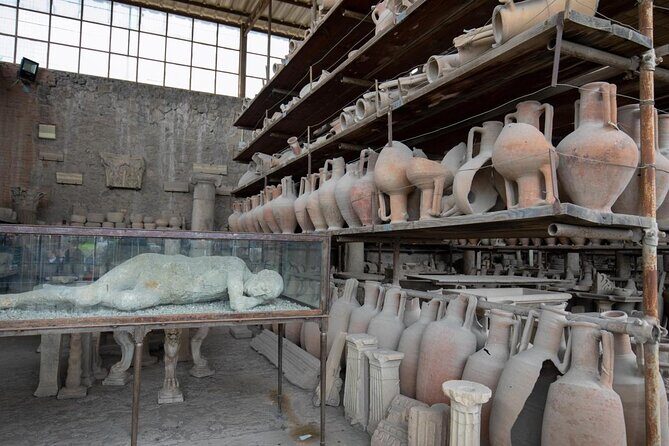
- Pompeii + Herculaneum in one day: compare the street-level city with the more intact villas.
- Guides in English for the ruins: groups are handled in small sections for better pacing.
- Tickets aren’t included: Pompeii, Herculaneum, and Vesuvius have separate entrance fees.
- Group size capped at 19: small enough to feel organized, large enough for comfort.
Why this Vesuvius–Pompeii–Herculaneum day works from Sorrento
If you want the classic Campania combo, this is one of the most efficient ways to do it. You’re not choosing between volcano views and Roman ruins. You get both, and the order matters: the Vesuvius moment gives you the context for what happened to Pompeii and Herculaneum.
The pace is also built around practical visiting time. You spend about 3 hours at Vesuvius, then 2 hours at Herculaneum, and 2 hours at Pompeii. That adds up to a full day (about 8 hours total), but it avoids the trap of trying to cram in everything with zero time to look closely.
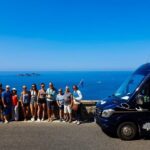
The other thing I like: you’re not left to figure it out alone. You travel with a driver and English-speaking guide support for the key sites, and the day is structured so you’re guided through the “where do I look?” problem that ruins can create.
You can also read our reviews of more tours and experiences in Sorrento.
- Sorrento Farm and Food Experience including Olive Oil, Limoncello, Wine tasting
★ 5.0 · 2,524 reviews


The Vesuvius National Park stop: drive up, then climb for the views
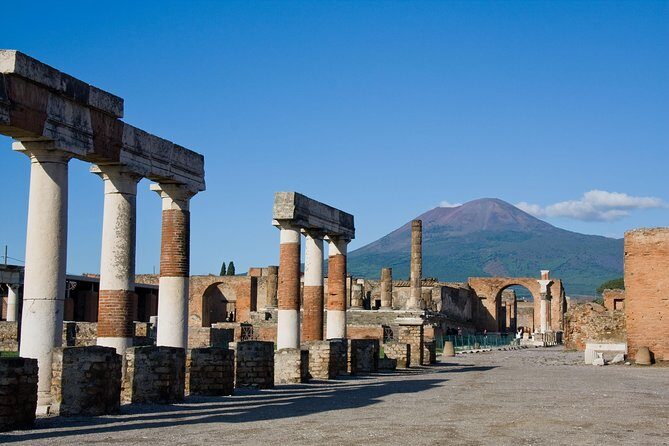
Vesuvius is the start of the story, so you head there first. The day’s volcano part begins with a scenic drive up into the park, then a hike to the top. The routine is straightforward:
- You drive up around 3,000 feet through the old crater road section.
- Then you do a final ~25-minute hike on volcanic gravel.
- The path zigzags as you rise, which helps you manage the incline without it feeling like straight climbing.
Once you’re at the summit, you’re right at the scale of the place: the crater is described as about 700 feet deep and roughly 2,000 feet wide. That’s not trivia for trivia’s sake. Standing there makes Pompeii and Herculaneum stop being distant history and become a nearby cause-and-effect you can picture.
What you’ll actually get from the crater look
You’re not just viewing a big hole. You’re seeing why people still remember this volcano so sharply. The crater viewpoint is the place to connect the dots: it’s the destroyer and the keeper of the sites you’ll visit next.
And the timing is built for good sightlines. On a clear day, you can take in the Peninsula of Sorrento plus the islands of Capri, Ischia, and Procida. That view isn’t the kind of postcard bonus that distracts you—it helps you understand why this region drew people in the first place: coastal access, fertile surroundings, and a landscape that invites settlement.
Practical note: this portion includes a hike over gravel. It’s not a technical climb, but your shoes should be comfortable and grippy. You’ll want to move steadily, especially if the path feels loose underfoot.
Pompeii Archaeological Park: streets, buildings, and the feeling of time travel
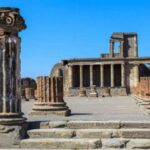
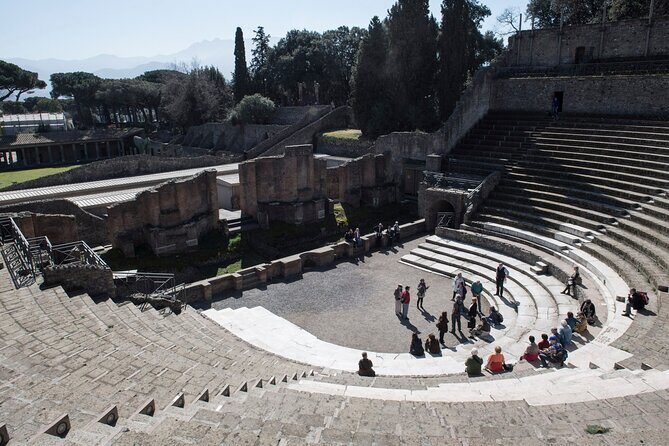
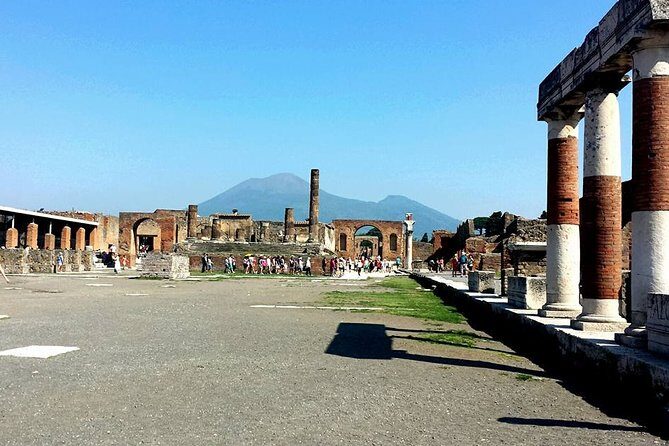
Pompeii is the best-known site for a reason. You get to walk an open-air museum where the city’s streets and buildings have been preserved for over 2,000 years. The result is you’re not looking at scattered ruins—you’re navigating a town.
In this itinerary, Pompeii gets about 2 hours. That’s just enough time to see the highlights without turning it into a blur. What you’re doing in that window is simple: start with an orientation, then follow the guide’s route so you understand how the blocks and buildings were laid out and what you’re looking at.
One smart way to enjoy Pompeii with limited time is to focus on your senses: imagine daily sounds (street life), small details (doorways and wear marks), and the layout. With a guide, you can connect the visual to the lived experience, instead of getting stuck on facts you can read later.
Heads-up: Pompeii has an entrance fee (€19 per person) that isn’t included. So budget for that in advance.
Herculaneum: smaller than Pompeii, and unusually intact
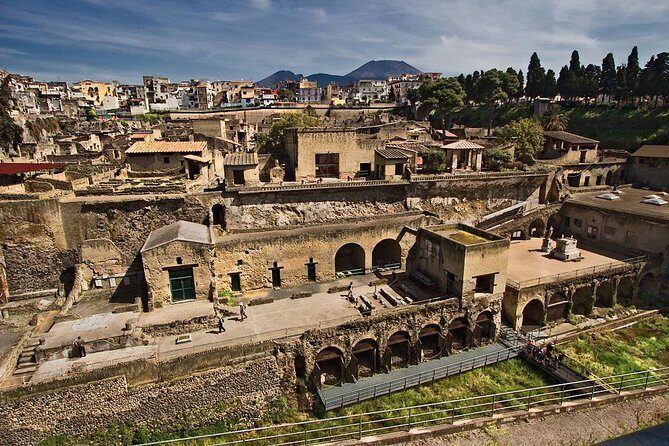
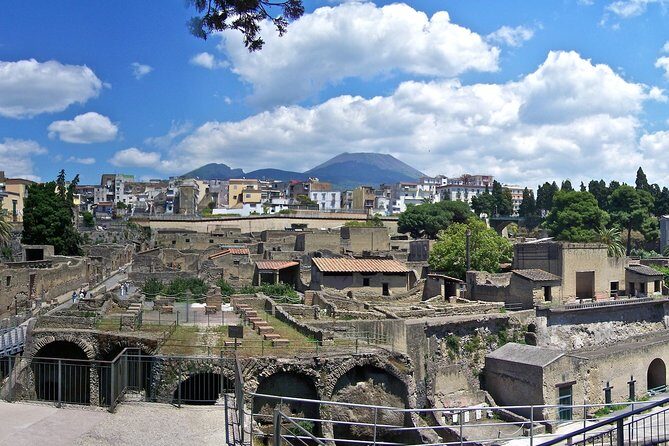
Herculaneum is where you feel the difference between the two cities. It’s often described as the smaller sibling of Pompeii, and it has a reputation for beauty and preservation. Here, you’re mainly looking at structures that feel more complete—especially the patrician villas and their details.
This stop is about 2 hours, and it’s special for the kind of artifacts you can still recognize in context. The site is noted for:
- intact villas (and the sense of space inside them)
- decorative mosaics and frescoes
- a level of preservation that’s striking given the force of the volcanic flows
The temperature and violence of the eruption (described as around 500°C in the tour info) help explain why Herculaneum can look so sharply preserved compared with Pompeii. It’s one of those places where you start looking at material texture and craftsmanship, not only building shapes.
Also, plan for the entrance fee: €18 per person for Herculaneum, not included.


How the guiding works (and why it matters in ruins)
This tour keeps groups manageable. For Pompeii and Herculaneum, you’re handled as a small group (not a huge crowd with one voice). The plan is described as:
- groups of 6–8 with an English-speaking guide for those sites
Across the rest of the day (travel by minibus plus guide/driver support), group sizes are described as:
- groups of 9–19 in a minibus with driver and English-speaking guide
In plain terms: you get more back-and-forth and less “stand here and hope you can hear.” And the site experience is more coherent—because a guide can point out why a detail matters (for example, where to look for decoration, and what to notice in street-level remains).
You can also benefit from guide personalities. Past departures have included guides such as Tiziana and Floriana (praised for sharing a wealth of information and bringing energy), Andrea (praised for attentive pacing and safety), and Dario (praised for making everyday life in Pompeii feel understandable).
For the drive day flow, the driver can make a big difference too. Corrado is noted for helping smooth over a Vesuvius ticket hiccup when it came up, which is exactly the kind of calm competence you want on a packed day.
Tickets and entry fees: the part that needs your attention
This is where you should be a little boring and organized. The tour price includes the logistics and the guide/driver time, but site admissions are not included:
- Pompeii: €19 per person
- Herculaneum: €18 per person
- Vesuvius: €12 per person (for the 10:00 AM entrance from Sorrento)
Now comes the rule that matters most: Vesuvius tickets are not changeable and not refundable, and they must be pre-purchased online. If there’s one thing you do early at home, make it this.
If you forget, or if your confirmation doesn’t line up with the time slot, you may lose time at the start of the day—something this itinerary can’t spare. A good driver can help when tickets are messy, but the best solution is still to plan ahead.
Price and value: is € and time ratio worth it?
The tour price listed is $246.68 per person, and the day runs about 8 hours. That number isn’t just for “being taken places.” You’re paying for:
- a minibus, driver, and English-speaking guide
- time spent at three major sites
- taxes, parking, tolls, and gasoline
Then you add what you must cover separately:
- €12 Vesuvius + €19 Pompeii + €18 Herculaneum (entrance fees not included)
So your total spend is really the tour price plus admissions. That’s still often value compared to booking each site with separate transfers and trying to manage timing alone—especially with a tight start time and a volcano hike.
The “value test” I use: will you actually see the places, or will you spend the day buffering (waiting, guessing, correcting)? The structured timing here lowers that risk.
Time management: what the day feels like from start to finish
The tour starts at 8:00 am. From there, you’re moving all morning through the volcano area, then continuing into the ruins.
Stop timing is set:
- Vesuvius National Park: ~3 hours
- Herculaneum: ~2 hours
- Pompeii: ~2 hours
It’s a full day with walking. You’ll want to plan for a “do it all, but don’t rush it” mindset. If you try to sprint ahead of the guide to cover extra sights, you’ll burn energy before Pompeii even starts.
If you get motion-sensitive, keep expectations realistic. The minibus ride is part of the experience, but it’s still a day with movement and some hills around the park.
What to bring for comfort (and a smoother hike)
Food and drinks are not included, so you’ll want to handle your own snacking and hydration. For this itinerary, I’d pack like this:
- comfortable walking shoes for gravel and uneven ground
- a light layer (morning can feel cooler)
- water and a small snack plan
- sun protection (even when it’s not beach weather)
At Vesuvius, the gravel hike is short but noticeable. Your comfort there sets the tone for the rest of the day. In Pompeii and Herculaneum, you’ll do lots of walking with time spent looking closely, so supportive footwear matters more than you’d think.
Who this tour fits best
This itinerary is ideal if you:
- want the big three (Vesuvius, Pompeii, Herculaneum) without building multiple days
- like historical context that comes from seeing the cause first, then the effects
- prefer guided structure at ruins so you don’t miss the point
- are comfortable with a short hike at the volcano
It’s also a good match if you’re traveling with a mixed group—adults who want history and views, plus anyone who wants a clear plan from start to finish.
Should you book this tour?
Yes, if you’re the type who wants a single, organized day that meaningfully connects the volcano to the Roman cities. The volcano viewpoint plus the contrast between Pompeii’s broader street remains and Herculaneum’s more intact villas is a smart pairing.
Book it if:
- you’ll buy the Vesuvius ticket online in advance (non-changeable, non-refundable)
- you’re okay paying Pompeii and Herculaneum entrances separately
- you want an English-guided experience with small-group pacing
Skip it (or consider a slower option) if:
- you hate early starts
- you want lots of free time wandering without a schedule
- you aren’t comfortable with a short gravel hike
One more practical tip: since the start time is 8:00 am and the Vesuvius slot from Sorrento is 10:00 AM, plan your timing so you’re not juggling last-minute ticket issues.
FAQ
What time does the tour start and how long is it?
The tour starts at 8:00 am and lasts about 8 hours.
Are the entrance fees included in the price?
No. Pompeii is €19 per person, Herculaneum is €18 per person, and Vesuvius is €12 per person. Those admission tickets are not included.
Do I need to pre-purchase a Vesuvius ticket?
Yes. The Vesuvius tickets must be pre-purchased online, and they are not changeable and not refundable. The entrance time from Sorrento is listed as 10:00 AM.
How long do you spend at each site?
You spend about 3 hours at Vesuvius National Park, 2 hours at Herculaneum, and 2 hours at Pompeii.
What group size should I expect?
For Pompeii and Herculaneum, the guide supports groups of 6–8 people. For the rest of the excursion, groups of 9–19 use a minibus. The tour maximum is 19 travelers.
Does the tour include an English-speaking guide?
Yes. The driver and English-speaking guide are included for the excursion, including Pompeii and Herculaneum.
Are children admitted for free at Pompeii and Herculaneum?
Children under 18 enter for free at Pompeii and Herculaneum with a valid form of ID.

More Tour Reviews in Sorrento
- Sorrento Farm and Food Experience including Olive Oil, Limoncello, Wine tasting
★ 5.0 · 2,524 reviews