REVIEW · SORRENTO
Skip the Line Pompeii Guided Tour from Sorrento
Book on Viator →Operated by Acampora Travel · Bookable on Viator
Pompeii makes more sense with a guide. This skip-the-line half-day tour from Sorrento is built for people who want the big sights without getting lost in the crowds, and it comes with headsets so you can actually follow the stories as you walk. I like that it also includes your Pompeii entry ticket and guided route through the Forum, Teatro Grande, and the Stabian Baths.
You’ll appreciate the tight focus: instead of wandering randomly for hours, you get guided context at the places that shaped everyday Roman life. The only real trade-off is the walking: Pompeii’s surfaces are uneven, so this isn’t a great fit if you have mobility limits.
Why this Pompeii tour is worth your time
- Skip-the-line entry paired with a guided route so you start seeing important stuff fast
- Headsets that make the guide easy to hear on crowded streets and in noisy areas
- A Forum-centered itinerary (Basilica, Macellum, civil Forum, Granai) that explains how the city worked
- Stabian Baths heating details that turn ruins into something you can picture
- Small group size (maximum 30 travelers) that keeps the pace human and questions possible
In This Review
- From Sorrento to Pompeii: what “half-day” really means
- Skip-the-line entry plus a guide: the smartest way to beat Pompeii confusion
- The Pompeii Forum route: where the city breathed
- Forum basics: civic life in public spaces
- Basilica: the courtroom and business hub
- Macellum: the market with an imperial-cult angle
- Civil Forum (short, but useful)
- Granai del Foro: food storage and a window into excavations
- Teatro Grande: a Roman theater built into the hillside
- Stabian Baths and their heating system: why this stop feels real
- Pace, comfort, and the group size that keeps it enjoyable
- Value check: is $107.17 a good deal for Pompeii from Sorrento?
- Who should book this Pompeii tour (and who should skip it)
- Should you book this Sorrento to Pompeii skip-the-line tour?
- FAQ
- How long is the Pompeii guided tour from Sorrento?
- What does the tour cost?
- What’s included in the ticket price?
- Is the guide offered in English?
- Is skip-the-line entry included?
- Do I get headsets?
- Is pickup available from Sorrento?
- Is the tour suitable for mobility problems?
- Where does the tour end?
- Is free cancellation available?
From Sorrento to Pompeii: what “half-day” really means
This is a practical 4 to 5 hour experience that’s meant to fit cleanly into a day in Sorrento. You’ll ride in an air-conditioned bus, and there’s live commentary on board before you even reach the archaeological park.
The plan is designed around time on foot. Your stops are short at each highlight, so you’ll move at a steady pace and still get meaningful context from your English-speaking guide. That pacing is exactly what you want at Pompeii, because the site is huge and easy to misread without someone pointing out what matters.
Pickup is offered from Sorrento, with the pick-up window starting about 45/30 minutes before departure (your exact time is confirmed with the local operator). Since Sorrento has traffic restrictions, I recommend treating the confirmation message like your main “schedule anchor,” not a suggestion.
Skip-the-line entry plus a guide: the smartest way to beat Pompeii confusion
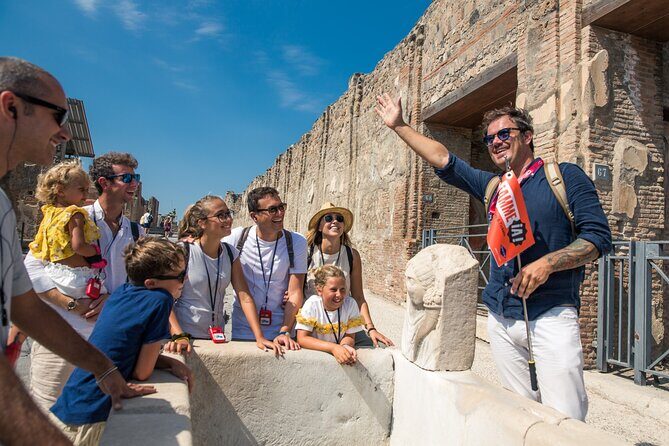
Pompeii is crowded, and it’s also easy to get turned around. Even if you’re reading a guidebook, you can miss how spaces connect—what was civic life, what was religious, where trade happened, and what the buildings were for.
This tour gets you in with Pompeii admission included, and it’s marketed as skip-the-line, which matters when you’re trying to maximize your sightseeing time. Then the guide helps you translate what you’re seeing: the Forum isn’t just “big ruins,” it’s the city’s decision-making and daily rhythm.
And the headsets are a big deal. When you’re shoulder to shoulder with other groups, you don’t want to keep craning your neck or guessing what the guide is saying. With the audio gear, you can listen without constantly turning your body.
You can also read our reviews of more guided tours in Sorrento

The Pompeii Forum route: where the city breathed
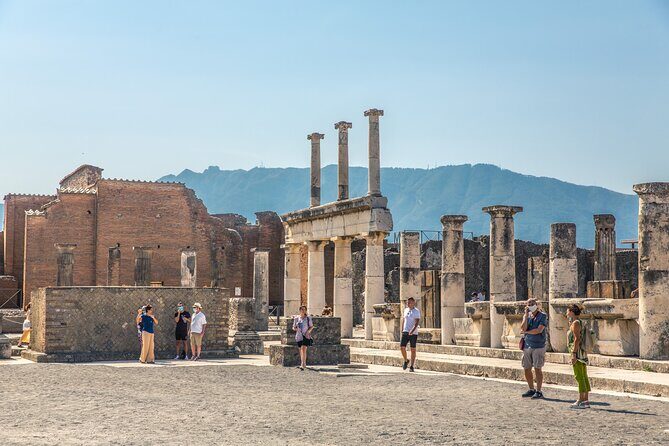
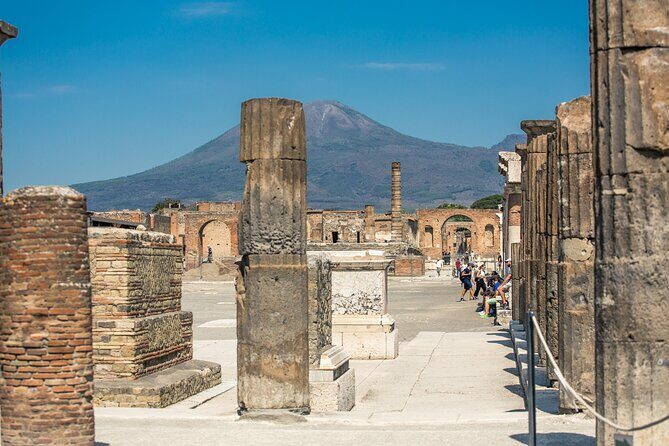
The heart of this tour is the Forum area, and it’s a smart choice because it concentrates the most important buildings in the clearest walking path. This stop runs about 2 hours, so you’re not just getting a quick glance—you get time to understand the layout.
Forum basics: civic life in public spaces
You’ll follow the guide through the Forum, described as the heart of Pompeii surrounded by key public buildings. This is where the Basilica sat, where religious elements existed close by, and where the Macellum (food market) added everyday commercial energy.
I love this approach because it teaches you how Romans used space. In Pompeii, you can see that the city wasn’t divided into separate worlds. Government, business, and worship all shared the same neighborhood of stone and streets.
Basilica: the courtroom and business hub
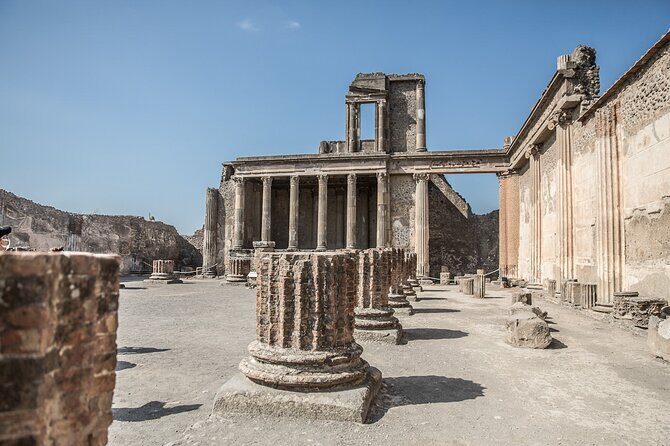
Next up is the Basilica, with a large footprint (about 1,500 square metres) and a central role in both administration and justice. You’ll see how people accessed it from the Forum through multiple entrances and how the interior was organized into multiple naves.
One detail that helps the Basilica click is the setting of the judges’ space. The suggestum area in the center of the short western side is where judicial affairs were managed. Once you understand that, you can look at doorways and columns and realize this wasn’t just decoration—it was built for work and verdicts.
Macellum: the market with an imperial-cult angle
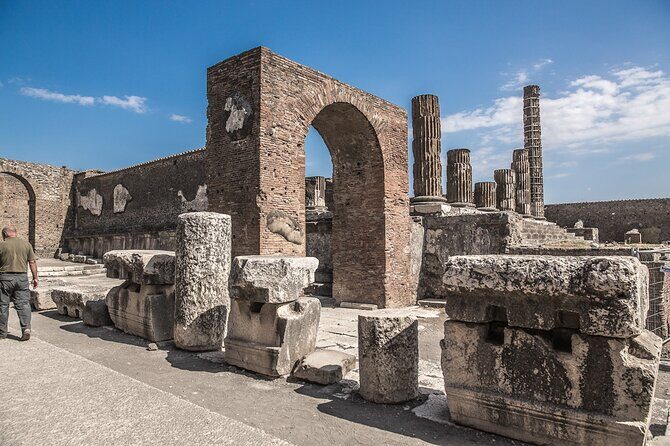
Then comes the Macellum, the food market. It’s structured around a tuff quadriporticus, with a worship hall on the elevated eastern side aligned with the entrance.
I like this stop because it shows how food, commerce, and politics braided together. The market included marble statues in niches and hints of the imperial cult, meaning this place wasn’t just where you bought dinner. It was also where you interacted with Rome’s authority.
You can also spot the functional side: a masonry counter suggests areas where items like fish could be sold, linking the architecture to daily routines.
You can also read our reviews of more tours and experiences in Sorrento



Civil Forum (short, but useful)
There’s also a shorter segment timed to the Civil Forum, described as the core of daily life. You’ll get a quick look at the focal point for administration, justice, business management, and trade activities like markets—so you leave the Forum area understanding what each cluster of buildings was for.
This part is brief, so don’t expect an in-depth lecture on every corner. Do expect the guide to connect the dots so you don’t leave Pompeii with a memory of “cool ruins” but no sense of city function.
Granai del Foro: food storage and a window into excavations
On the west side of the Forum, you’ll reach the Granai del Foro. These are large storerooms (eight openings with brick pillars) tied to the fruit and vegetable market, called Forum Holitorium.
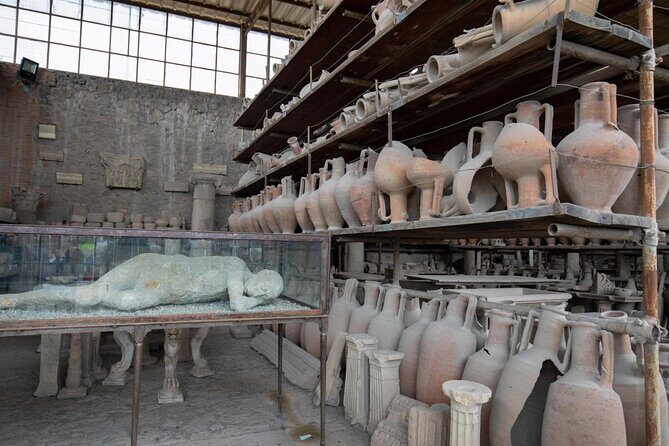
Here’s a detail that I think most people would miss without guidance: these storage spaces hold what’s described as the greatest archaeological inventory of the city. They preserve terracotta crockery used in the last decades of Pompeii’s life—pots, jugs, bottles, and amphorae for oil, wine, and fish sauce. That’s the “how people ate and moved goods” layer, not just architecture.
It’s also a reminder that Pompeii isn’t frozen in time for us—it’s constantly being studied. The Granai feel like a working archive, even as you stand among ruins.
Teatro Grande: a Roman theater built into the hillside
Teatro Grande is a short stop (around 10 minutes), but it’s still worth it because it shows a Roman engineering idea you can’t fully appreciate from a photo. The theater was built by using the natural slope of the hill.
You’ll notice how the seating and circulation were organized. The staircase separated into areas with corridors, and those corridors were divided into sectors. There’s also a passage with a barrel vault behind the scenes of how people moved in and out.
One standout is the timeframe and restoration notes: the theater dates to the middle of the 2nd century BC and was restored in Roman style later. There’s an inscription near the corridor entrance that recalls Augustan-age works by an architect named Marcus Artorius Primus.
I like short stops like this when the guide points to the structural logic. It turns a quick photo stop into a “now I get how it worked” moment.
Stabian Baths and their heating system: why this stop feels real
The Stabian Baths (Terme Stabiane) are among the oldest Roman bath complexes known. Your walk-through here is timed about 10 minutes, but it’s designed to give you a clear visual of how people moved through temperature zones.
You’ll start at the main entrance on via dell’Abbondanza, then see a large courtyard. From there, the pool sits to the left, while a colonnade leads toward the men’s quarters and the sequence of rooms.
The temperature flow is the big idea:
- apodyterium (dressing room)
- frigidarium (cold baths)
- tepidarium (medium temperature baths)
- calidarium (hot baths)
What makes this area more than just “old ruins” is the heating system description. Heat came from piping in the walls and double floors that circulated hot air from furnaces and mobile braziers. Once you understand that, you can picture the building working, not just sitting there.
If you’ve only ever seen bath complexes in modern museums, this stop helps you feel the daily rhythm. Bathing wasn’t one room. It was a carefully organized route.
Pace, comfort, and the group size that keeps it enjoyable
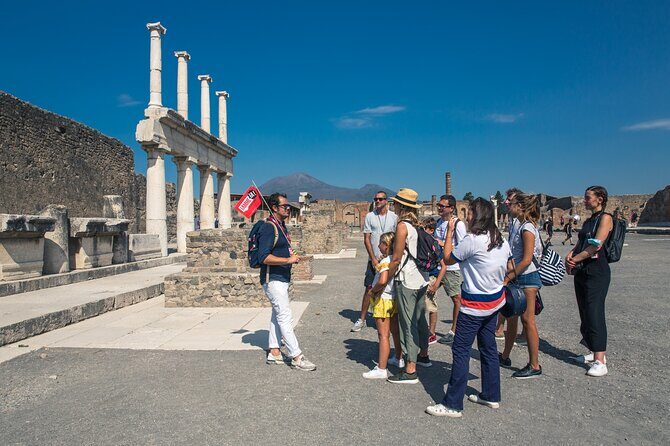
This tour caps group size at 30 travelers, with a maximum of about 30 people per guide. In plain terms, it’s small enough to keep conversations possible and to avoid the chaos you get with huge groups.
The tour is also built with smart communication in mind. Headsets help a lot on a site where noise and distance can ruin your ability to listen.
The practical part: Pompeii is uneven, and the walking is real. If you’re dealing with knees, mobility devices, or balance concerns, you’ll likely feel this quickly. Plan for solid shoes and an honest view of how much time you’ll spend on foot.
Also note that the route and timing can shift with local traffic and unforeseen circumstances. It’s a half-day schedule, so staying flexible is part of the deal.
Value check: is $107.17 a good deal for Pompeii from Sorrento?
At $107.17 per person, you’re paying for more than just a guided walk. Your price includes:
- air-conditioned bus transportation
- live commentary on board
- Pompeii admission ticket
- an English-speaking guide through the site
- headsets during the walking tour
For me, the value comes down to what you avoid:
- time wasted trying to coordinate on your own
- frustration when the site is crowded and you can’t hear explanations
- guessing which spaces matter most for how Pompeii functioned
You also get a focused route that hits the Forum core, a major public building (Teatro Grande), and two major “daily life” complexes (the baths and the Granai). That combo is where a guide pays off, because you’re not just seeing ruins—you’re getting the city logic behind them.
The one missing piece is simple: no meal or drinks are included. You’ll want to plan water ahead of time and keep room in your day for a post-tour break.
Who should book this Pompeii tour (and who should skip it)
This tour is a strong fit if you want:
- a guided, structured introduction to Pompeii in a half-day format
- headsets and a small group size that supports questions
- a route focused on civic life, markets, theater, and baths
It may be less ideal if:
- mobility is a concern due to uneven surfaces
- you prefer long, free time exploring without guidance (this is a guided route with relatively short stop times)
If you’re traveling solo or as a couple, the small group size is a bonus. If you’re traveling with friends who like history but don’t want to spend your whole day stuck in logistics, this format usually works well.
One extra note from real guide experience: I’ve seen guides such as Carmela lead these tours with a friendly, animated style and point out active excavation areas. That kind of detail can make the ruins feel less like a finished postcard and more like a living research site.
Should you book this Sorrento to Pompeii skip-the-line tour?
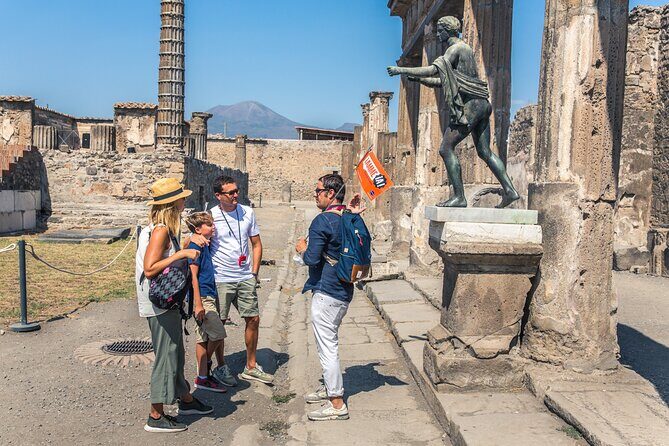
I’d book it if you want Pompeii to make sense fast. The combination of skip-the-line entry, admission included, an English guide, and headsets turns a crowded site into something you can actually follow. Plus, the Forum-first route is a smart use of your limited half-day window.
Skip it only if you know you want a slower pace and lots of independent exploration, or if uneven walking is a problem for you.
If you can handle a steady guided walk and you’re excited to understand how daily life worked in Pompeii, this is a solid, practical choice.
FAQ
How long is the Pompeii guided tour from Sorrento?
It runs about 4 to 5 hours (approx.).
What does the tour cost?
The price is listed at $107.17 per person.
What’s included in the ticket price?
You get air-conditioned bus transportation, live commentary on board, Pompeii entry ticket, an English-speaking guide, and headsets during the walking tour.
Is the guide offered in English?
Yes, the tour is offered in English.
Is skip-the-line entry included?
The tour is marketed as a skip-the-line experience, and the Pompeii admission ticket is included.
Do I get headsets?
Yes, headsets are provided during the walking tour.
Is pickup available from Sorrento?
Pickup is offered. Your pick-up time starts 45/30 minutes before departure, but you must confirm the exact time and location with the supplier before you go.
Is the tour suitable for mobility problems?
No. Due to uneven surfaces, it is not suitable for people with mobility problems.
Where does the tour end?
It ends back at the meeting point.
Is free cancellation available?
Yes. You can cancel for a full refund up to 24 hours in advance of the experience’s start time. If you cancel less than 24 hours before, the amount paid is not refunded.




More Guided Tours in Sorrento



More Tours in Sorrento





More Tour Reviews in Sorrento
- Sorrento Farm and Food Experience including Olive Oil, Limoncello, Wine tasting
★ 5.0 · 2,524 reviews