REVIEW · SORRENTO
Skip the line Pompeii Guided Tour
Book on Viator →Operated by Buyourtour di Amo Italy Travel · Bookable on Viator
Pompeii is huge, so timing matters. This 4-hour guided trip from Sorrento or Naples is built for first-timers who want the big moments fast, with skip-the-line style entry support and headsets so you can actually follow the story.
I like the way the route stitches together daily life in one sweep. You get a real sense of the city through the Forum, then the market zone at the Macellum, and you’re back out before the heat fully pins you to the ground.
One drawback: it’s a set schedule with short stops, so you won’t have time to wander off-script for long. And in at least one documented case, transportation changes led to waiting and some loss of the planned flow.
In This Review
- Key highlights worth your attention
- Pompeii from Sorrento: the value of a half-day plan
- Getting to the site without losing your morning
- Stop 1: Archaeological Park of Pompeii and the “how did this survive?” moment
- Stops 2–4: Forum, Temple of Jupiter, and the Macellum market culture
- Temple of Jupiter: Vesuvius in your view
- The Macellum: the city’s market heartbeat
- Stop 5–7: Via dell’Abbondanza, Stabian Baths, and the brothel
- Stabian Baths: where routines met engineering
- The brothel: brief, but hard to unsee
- Stop 8: Teatro Grande and how to picture shows in stone
- Pace, group size, and comfort on a 30-seater bus
- Who should book this Pompeii guided tour (and who should skip it)
- Should you book this Pompeii guided tour?
- FAQ
- How long is the Pompeii guided tour?
- Is the Pompeii entrance ticket included?
- What language is the guide?
- Do I get headsets to hear the guide?
- Where does pickup happen?
- Is lunch included?
- How large is the group?
- Is the tour weather dependent?
- Can I get a full refund if I cancel?
Key highlights worth your attention
- Entrance ticket is included, so you skip the extra purchase step at the gate.
- Authorized English guide for 2 hours, plus headsets to hear clearly.
- A focused Pompeii loop: Forum, Temple of Jupiter, market, baths, brothel, and theatre.
- Built for time-crunched visits with about 4 hours total.
- 30-seater bus and pickup from Sorrento or Naples to reduce hassle.
- Max group size is capped at 100, helping keep the experience organized.
Pompeii from Sorrento: the value of a half-day plan
Pompeii can swallow a whole day, mostly because you keep stopping to look. This tour is designed around the opposite idea: pick the key zones, explain what you’re seeing, and get you back on schedule. That makes it a strong option when your Amalfi Coast schedule is packed or you only have one shot at Pompeii.
At $96.38 per person for about 4 hours, the price can look steep until you break down what’s included. You’re paying for the friction-free parts: pickup, a coach ride, an authorized English guide for a good chunk of the visit, headsets, and the Pompeii entrance ticket. Lunch is not included, so you’ll want to plan for a snack and water outside the tour time.
This is also one of those tours that benefits from being early in the day. One family in the feedback got a start that helped avoid getting cooked by lunchtime, which is a big deal at Pompeii’s open-air walk-through.
You can also read our reviews of more guided tours in Sorrento

Getting to the site without losing your morning
You’ll start with pickup at a meeting point in Sorrento or Naples. The ride uses a 30-seater bus, and the tour keeps things simple so you’re not figuring out transfers on your own.
Two details matter a lot for a smooth trip:
- Headsets: Pompeii ruins are loud in their own way—wind, footsteps, groups moving. The headsets help you keep up with the guide rather than playing catch-up.
- Mobile ticket: you don’t want to waste time dealing with paper and queues once you reach the entry area.
Practical tip: bring comfortable shoes and a light layer. Even if the weather looks perfect in Sorrento, Pompeii’s sun and stone can feel like a different climate once you’re out in the open.
Stop 1: Archaeological Park of Pompeii and the “how did this survive?” moment
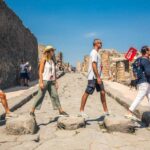
The heart of the day is your first stop: the Archaeological Park of Pompeii, where you spend about 2 hours. Pompeii is preserved because of the catastrophic eruption of Mount Vesuvius in 79 AD, when the city was buried under meters of ash and pumice. That layer is the reason you can walk through streets and see homes as if the city paused mid-life.
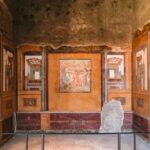
What I love about this first block is that it sets the framework. If you start at Pompeii without context, it can feel like random stone rooms and columns. With a guided flow, you start to understand how the spaces functioned—streets, doorways, public-facing areas, and the way people lived around the city’s routines.
Keep expectations realistic. Two hours sounds long, but Pompeii is vast and still being excavated. So this part is best thought of as: you get a guided sweep across a meaningful slice, not a full-city replacement for wandering on your own later.
If you have mobility limits or want to read every inscription slowly, this may feel fast. The upside is that you get a strong “first Pompeii” experience that doesn’t require months of planning.
Stops 2–4: Forum, Temple of Jupiter, and the Macellum market culture
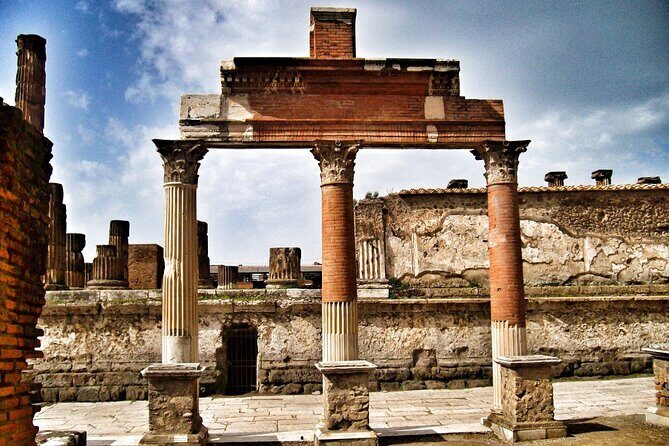
After you’ve got your bearings in the park, the itinerary leans into the place where public life happened: the Forum de Pompeya. This portion is short—about 10 minutes—but it’s an important orientation point. The Forum was the center for administration and justice, plus business and commercial activity, with places of worship all around it.
Even in a brief stop, try to watch for the big idea: the Forum wasn’t only politics. It was daily movement—people going about work, trade, and religious routines in one shared core.
Temple of Jupiter: Vesuvius in your view
Next is the Tempio di Giove Capitolino (about 15 minutes). The Temple of Jupiter dominates the north side of the Forum. And this is where the setting becomes dramatic: Vesuvius rises behind it, so the ruins aren’t just ancient artifacts—they’re placed in a landscape that still feels tied to the story.
You’ll hear that after the colony (around 80 BC) the temple was renovated and became a true Capitolium, similar to the one in Rome. The cult statues of Jupiter, Juno, and Minerva were placed on a high base, meant to be visible to people passing through the Forum square.
If you want a quick checklist, look for how the temple’s positioning makes it a focal point. It wasn’t built to blend in.
You can also read our reviews of more tours and experiences in Sorrento


The Macellum: the city’s market heartbeat
Then comes the Macellum (about 15 minutes), the city market. This isn’t just a snack stop in ancient form. It had an elevated hall for worship on the eastern side, and porticoes decorated with scenes of daily life—like selling fish and poultry—alongside mythological subjects.
The Macellum’s placement matters too. It stayed out of the main square area to reduce crowding, because lots of people flowed through Pompeii. In other words, Pompeii planned for business crowds, even if the city couldn’t plan for an eruption.
This is one of the stops where you start to feel how practical Roman life was. It’s architecture serving real needs: food, commerce, and a bit of religion tied in.
Stop 5–7: Via dell’Abbondanza, Stabian Baths, and the brothel
From the Forum zone, the route moves along Via dell’Abbondanza (about 10 minutes). This main street connects the Forum with the Amphitheatre. A quick walk here does something useful: it gives you a sense of how the city’s major public spaces linked together.
Stabian Baths: where routines met engineering
Next is the Stabian Baths (about 15 minutes). The baths were built in phases, with an early construction dating back to the 4th BC. You’ll pass through the main entrance by Via dell’Abbondanza, reaching a large courtyard. From there, the pool is on the left, and a colonnade on the right leads into the men’s quarters.
The internal layout is part of the “wow” factor:
- Apodyterium (dressing room)
- Frigidarium (cold baths)
- Tepidarium (warm baths)
- Caldarium (hot baths)
Heating wasn’t guesswork. Hot air ran through piping systems in the walls and through double floors fed by furnaces and mobile braziers. The men’s side has more visible decoration, while the women’s quarters are similar in layout but smaller and without rich decoration.
This stop is excellent if you want your Pompeii to feel like a living city, not just a museum of ruins. Baths were social. They were also infrastructure.
The brothel: brief, but hard to unsee
Then you’ll see the brothel of Pompeii (about 15 minutes). It’s famous for erotic paintings and built beds in a building with two floors. The owner and enslaved people lived above, while the lower level has five rooms, each fitted with a built-in bed.
The text also notes that many prostitutes were Greek and Oriental slaves. The building’s name comes from Lupa, a Latin word meaning prostitute.
Important reality check: this stop is explicit. It’s not graphic in a modern sense, but it’s still adult content. If that’s uncomfortable for you, decide how you want your Pompeii experience to feel ahead of time. If you’re traveling with young kids, this is a moment to handle carefully or skip mentally and focus on the big picture of ancient life.
Stop 8: Teatro Grande and how to picture shows in stone
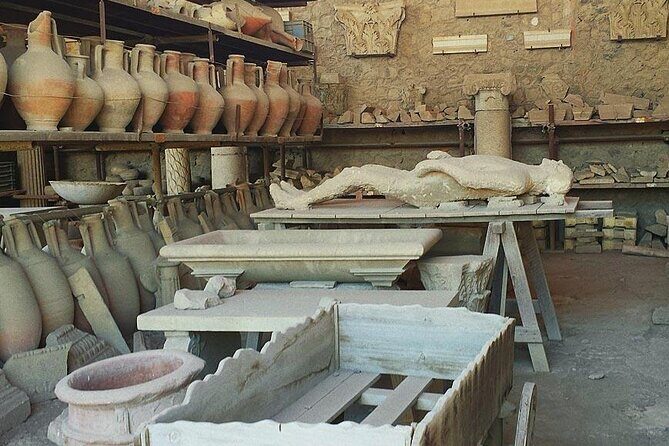
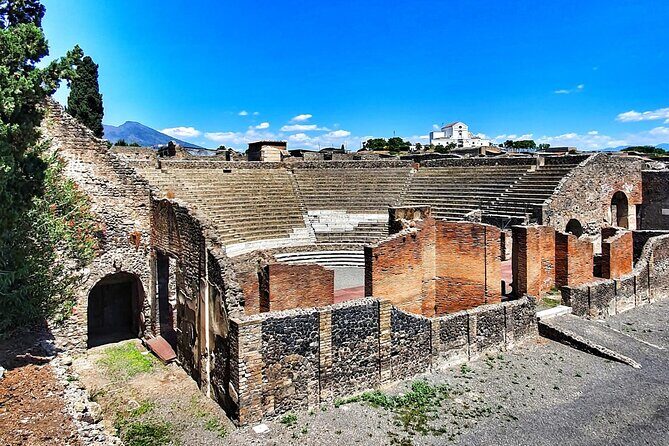
The final named stop is Teatro Grande (about 15 minutes). It was built around the middle of the 2nd century BC and later restored in a Roman style. Here, performances included comedies and tragedies from Greek and Roman traditions.
What I like about ending here is that it shifts you from “daily life” into “public entertainment.” It’s another way of understanding the city’s rhythms. Pompeii wasn’t just work and food—it also made room for mass gatherings and storytelling through theatre.
The info also notes something conservation-related: it was the first large public building completely freed from eruption deposits. So you’re seeing a place that was also part of how archaeologists learned to clear and interpret large spaces.
Pace, group size, and comfort on a 30-seater bus
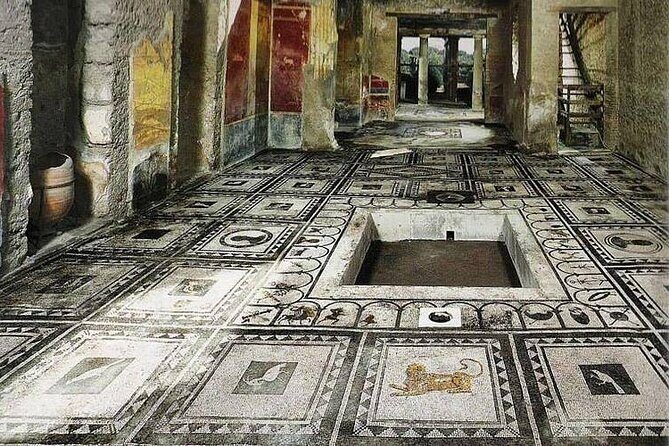
This tour says it can take up to 100 travelers maximum. In practice, you’re riding in a 30-seater bus, and the headsets help keep communication clear even in a larger overall operation.
The pace is controlled, with each stop timed. That’s good if you want structure. It can feel rushed if you prefer to slow down and study details or take lots of photos without moving to keep the group flowing.
Comfort is mostly handled by the bus ride and the guide setup. In the positive feedback, people praised the tour guide and the coach comfort, and one family appreciated help with their pram while moving through the ruins. Not every trip will be identical, but it’s a good sign that the operation thinks about basic visitor needs.
Who should book this Pompeii guided tour (and who should skip it)
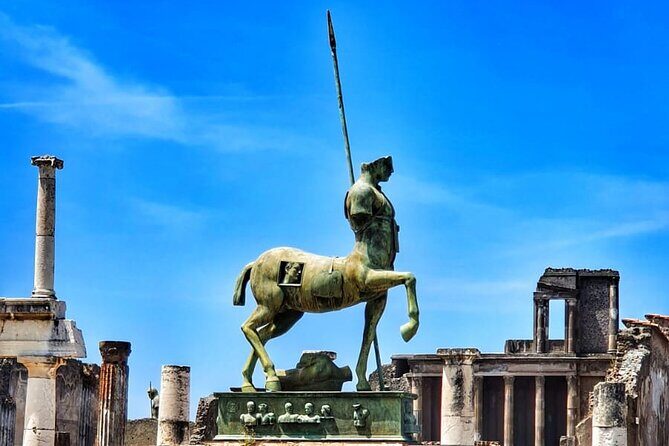
I’d put this tour at the top of the list for:
- First-timers who want a solid Pompeii overview in a half day
- People staying in Sorrento or Naples who want pickup and transfers handled
- Travelers who value a good guide and headsets to stay oriented
- Families who want an early start and some logistical support (especially if you need help navigating with a stroller)
I’d consider a different style of visit if:
- You want to roam freely and spend extra time in only one or two buildings
- You’re sensitive to adult content due to the brothel stop
- You prefer slow museum pacing over a timed route
A final note from real-world experience patterns: one booking had a rough patch when a bus problem led to a private minivan arrangement for a small group, plus waiting, a gift shop stop, and time loss. That’s not something you can plan for, but it’s worth remembering this tour can be flexible when transportation changes.
Should you book this Pompeii guided tour?
If you want a first, guided taste of Pompeii with entrance included, English commentary, and a smooth half-day plan from Sorrento, I think this is a good bet. The value is strongest when you compare what you get for your time: transfers, headsets, and a route that covers major public-life sites plus baths and theatre.
Book it if:
- You’re on a schedule
- You want the key sights without reading every stone on your own
- You appreciate a guide who helps you connect what you see
Skip it if:
- You want to linger for hours in the same area
- You strongly dislike the idea of a brief stop at the brothel
- You need a very flexible day, because this is structured and timed
FAQ
How long is the Pompeii guided tour?
It runs for about 4 hours.
Is the Pompeii entrance ticket included?
Yes. Your entrance ticket to Pompeii is included.
What language is the guide?
The tour includes an authorized English-speaking guide.
Do I get headsets to hear the guide?
Yes. Headsets are provided so you can hear clearly.
Where does pickup happen?
Pickup is at a meeting point in Sorrento or Naples.
Is lunch included?
No. Lunch is not included.
How large is the group?
The tour lists a maximum of 100 travelers, and the bus is a 30-seater.
Is the tour weather dependent?
Yes. It requires good weather. If it’s canceled due to poor weather, you’ll be offered a different date or a full refund.
Can I get a full refund if I cancel?
Yes. Free cancellation is allowed up to 24 hours in advance for a full refund.




More Guided Tours in Sorrento



More Tours in Sorrento





More Tour Reviews in Sorrento
- Sorrento Farm and Food Experience including Olive Oil, Limoncello, Wine tasting
★ 5.0 · 2,524 reviews