REVIEW · SORRENTO
Sorrento Walking Tour with a Local Guide
Book on Viator →Operated by IAMME IA! - Gray Line Amalfi Coast · Bookable on Viator
Sorrento feels like a movie set when you see it on foot. This 3-hour guided walking tour strings together the big sights and quieter corners, with time for photos and a smart mix of artisan craft stops plus a real street-food break. With a small group (up to 15), you get explanations that make the streets feel less random and more meaningful.
One heads-up: the route leans more toward history and viewpoints than a heavy food crawl, and you’ll walk through areas with steps and uneven pavement. If you’re the type who wants a long, full meal’s worth of tastings, plan to eat beforehand and think of food as part of the story—not the whole event.
In This Review
- Key Things to Know Before You Go
- Getting Your Bearings in Sorrento (Without Rushing)
- Piazza Torquato Tasso: Your Start Button for the Town
- Il Vallone dei Mulini: A Valley With a 37,000-Year Backstory
- Corso Italia Walk: The Main Street Moment (And What to Notice)
- Santi Filippo e Giacomo Cathedral: Neo-Gothic Outside, Baroque Inside
- Chiostro di San Francesco: The Cloister Where You Can Catch Your Breath
- Villa Comunale di Sorrento: Sea Views and a Garden That Actually Feels Local
- Marina Grande: Sorrento’s Old Fishing Port (And Movie History)
- Wood Inlay, Sandals, and the Craft Stops That Make Souvenirs Make Sense
- Street Food Tastings: A Snack-First Approach (Not a Full Food Tour)
- Guide Style Makes the Difference (From Danielo to Gabriela to Roberta)
- Pace, Steps, and What to Wear
- Price and Value: Why $59 Can Work (If You Want an Overview)
- Should You Book This Sorrento Walk?
- FAQ
- FAQ
- Where is the meeting point for the tour?
- How long is the walking tour?
- What languages is the tour offered in?
- What food and drinks are included?
- Is hotel pickup or drop-off included?
- How big is the group?
Key Things to Know Before You Go
- Small group size (max 15) keeps the pace human and questions easy
- Piazza Tasso + Torquato Tasso details give you instant context for the town
- Il Vallone dei Mulini turns an ordinary-looking valley into a 13th-century-and-beyond story
- Cathedral + cloister stops add architecture you can’t easily spot on your own
- Wood inlay craft focus connects what you see to what locals actually make
- Street tastings include items like lemon slices, salami-and-cheese, and deep-fried seafood
Getting Your Bearings in Sorrento (Without Rushing)
This tour is built for orientation. You start where most first-time walkers want to begin—near Piazza Torquato Tasso—then move through the historic center on foot until you return to the same meeting point. There’s no hotel pickup, so you’ll want to arrive a few minutes early and plug yourself into the day’s rhythm.
The group size matters here. With a maximum of 15 people, the guide can slow down when a question pops up, and you’re not shoved along like luggage. You should still expect plenty of walking and some climbing. Even the most scenic towns have their stairs, and Sorrento is no exception.
What I like most for value is that you’re not just ticking off “church, square, view.” You’re learning why those places exist and how locals connect them—poet and patron saint in one piazza, mills tied to ancient geology in another valley, and a fishing harbor that preserved its older identity while the rest of town modernized.
You can also read our reviews of more walking tours in Sorrento



Piazza Torquato Tasso: Your Start Button for the Town
The tour begins at Iamme Ia! – Gray Line Amalfi Coast Office, at Piazza Torquato Tasso (Piazza Torquato Tasso, 16). If you’re trying to understand Sorrento quickly, this is a good first stop because the square is packed with symbolism.
In Piazza Tasso, you’ll see the statue of S. Antonino Abbate, Sorrento’s patron saint. The square is named for poet Torquato Tasso, and that connection matters later when you visit the cathedral where he was baptized. The guide’s job here is to connect the dots so the town doesn’t feel like separate postcards.
This first segment is short—about 15 minutes—but it sets the tone. You’ll know what you’re looking at, and more importantly, you’ll know what it means.
Il Vallone dei Mulini: A Valley With a 37,000-Year Backstory
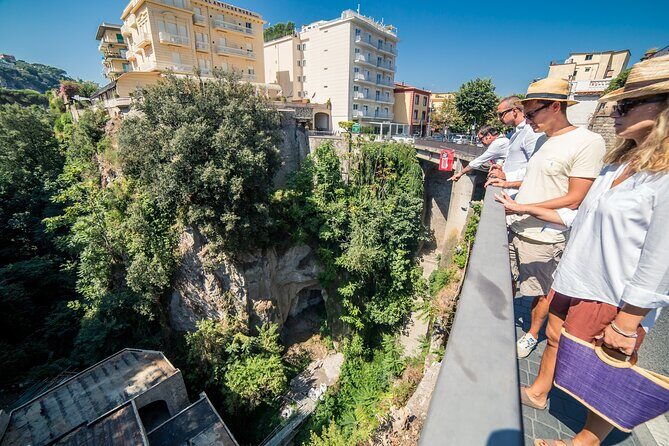
Next is Il Vallone dei Mulini, often translated as the Valley of the Mills. On the surface, it’s a historic valley tied to Sorrento’s water and industry. The tour makes it way more interesting by explaining how long-term geology fed into human work.
Here are the big ideas you’ll hear:
- The flour mills were built from stone as far back as the 13th century
- The valley’s name comes from milling grain—simple in concept, powerful in impact
- The story stretches deeper: the valley traces back to water released into a tufa plain around 37,000 years ago, linked to the Campi Flegrei eruption
- The mills operated until the early 10th century
- In 1866, the founding of Piazza Tasso helped isolate the mills and the surrounding sea
- The mills were closed and abandoned in the 1940s
It’s the kind of stop that makes you slow down. Even if you don’t become a geology fan overnight, you’ll start seeing the landscape as something shaped over time, not just scenic background.
Corso Italia Walk: The Main Street Moment (And What to Notice)
Between the major stops, you’ll walk along Corso Italia, the town’s main artery. This is not “just transit.” It’s your chance to absorb the town’s everyday textures—shopfronts, street layout, and the way the center funnels you toward squares and viewpoints.
If you’re coming straight from a hotel or train, this stretch can also help your legs adjust. Expect a steady pace and keep an eye on uneven sidewalks.
Santi Filippo e Giacomo Cathedral: Neo-Gothic Outside, Baroque Inside
One of the strongest stops is Cattedrale di Sorrento (Santi Filippo e Giacomo). It’s described as somewhat off the main flow—so you get that quiet, tucked-away feel even while you’re close to the busy center.
What makes the cathedral worth your time is the mix of eras:
- Originally built in the 11th century
- Reconstructed in the 15th century
- A Neo-Gothic facade added in 1924
- Inside, Baroque decorations and local marquetry (intarsia)
- A baptismal font tied to Torquato Tasso
If you like architecture that shows layers of change, this is one of those stops where the guide’s narration really pays off. You’ll walk in thinking it’s a church; you’ll walk out seeing it as a timeline.
You can also read our reviews of more guided tours in Sorrento






Chiostro di San Francesco: The Cloister Where You Can Catch Your Breath
After more walking and views, the Chiostro di San Francesco works like a pause button. It’s an oasis of quiet steps away from the central action.
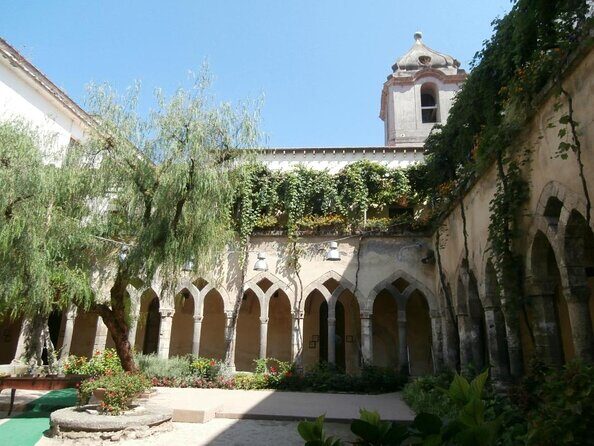
The cloister is built on the remains of a 7th-century monastery and dates back to the 14th century. You’ll learn that it unites religious spaces from different periods and that the architecture pulls from a wide range of influences—pre-Roman through Arabic to medieval. One practical tip: look closely at the columns. Each one is decorated differently, so it’s worth taking your time rather than treating it like a quick hallway.
There’s also a majestic pepper tree in the courtyard. That green focal point is perfect for a breather and for photos that feel more like a garden scene than a monument shot.
Important detail: this stop’s admission is not included, so budget for an entrance ticket if you want to go in.
Villa Comunale di Sorrento: Sea Views and a Garden That Actually Feels Local
Next comes Villa Comunale di Sorrento, set on gardens associated with Franciscan friars. This is where the tour delivers the “wow” factor without needing a separate boat trip.
You can picture what you’ll find: palm trees, holm oaks, and century-old pines overlooking the sea. The payoff is the view of the Gulf with Vesuvius dominating the horizon. Even if you’ve seen photos of the Bay of Naples before, this angle tends to feel more real—less like a screen, more like a place.
This stop is about 15 minutes, so don’t expect a long linger. Instead, use the time to:
- grab one wide photo showing the coastline and Vesuvius
- take one slower look so you remember the scale of the harbor and hills
Marina Grande: Sorrento’s Old Fishing Port (And Movie History)
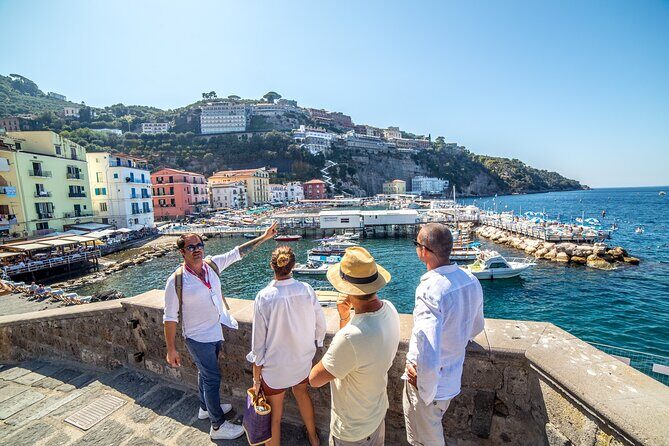
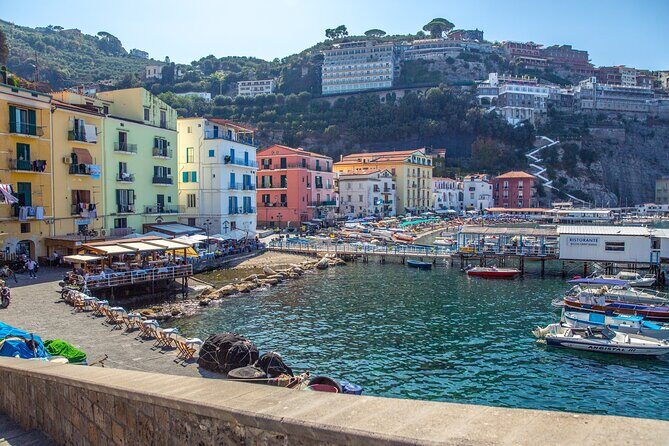
The final big highlight is Marina Grande – Antico Borgo Marinaro, Sorrento’s more authentic fishing village. It’s separated from the main town by a stone gateway built by the Greeks, and that separation creates a different feel almost immediately.
This is one of the places that makes the town feel layered:
- colorful wooden boats
- pastel-colored houses
- nets drying in the sun
- family-run restaurants known for fresh seafood
The tour also points out a surprising cultural link: Marina Grande served as a filming location for the classic 1954 movie Scandal in Sorrento, starring Sophia Loren. That detail helps you see past the scenery and into the town’s place in pop culture.
This segment is about 20 minutes—enough to soak in the harbor vibe, take photos, and start craving dinner, especially if the street-food break earlier was your warm-up.
Wood Inlay, Sandals, and the Craft Stops That Make Souvenirs Make Sense
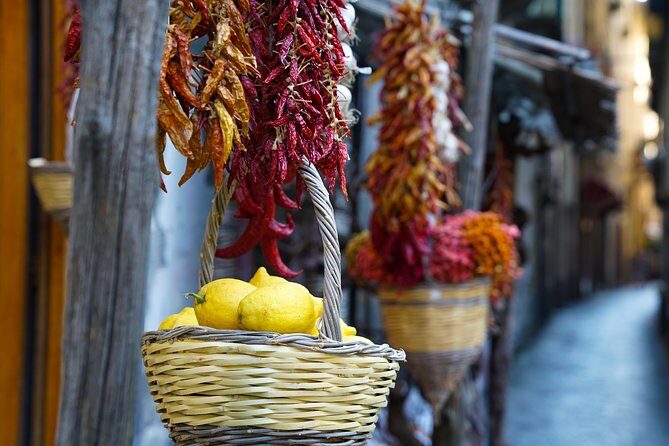
A big part of the experience is learning how locals make things, not just where to buy things. You’ll stop to discover traditional craft—especially wood inlay (intarsia)—and you may also encounter local artisan work related to items like leather sandals.
Why this matters: Sorrento souvenirs can be easy to dismiss as tourist clutter. Craft stops help you understand the labor behind what you’re seeing. Once you know what to look for, the details in an inlaid pattern or the quality signs in materials start clicking.
Even if you don’t plan to buy, this gives you a deeper reason to pay attention than sightseeing alone.
Street Food Tastings: A Snack-First Approach (Not a Full Food Tour)
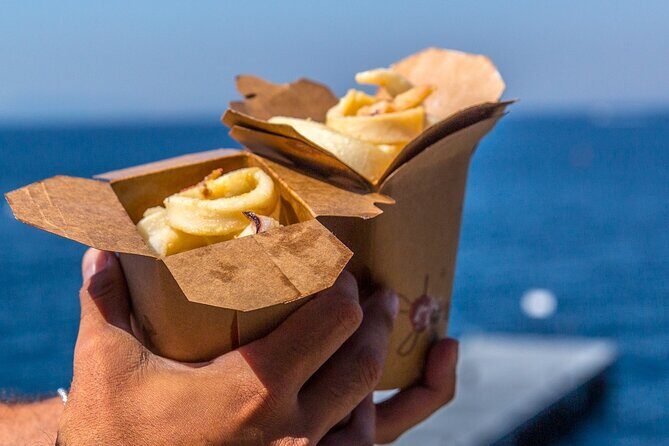
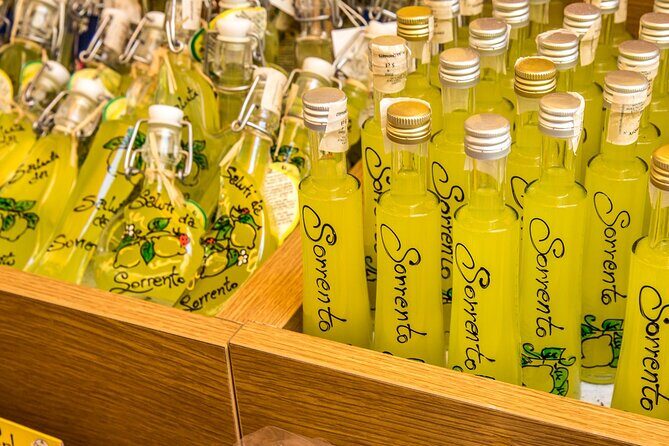
The tour includes a street-food component and a refreshing break—think sugar-coated lemon slices, salami and cheese, and deep-fried seafood. You’ll also get fresh orange or lemon juice, or lemon gelato.
Here’s how to set your expectations: the food is part of the walk. It’s a sampling, not a restaurant meal cycle. Several guides build it as a fun intermission between churches and viewpoints, and the best approach for your comfort is to eat lightly before you go.
If you want food to be the main event, choose a tour that clearly markets itself as a longer, heavier tasting route. This one is more about getting your bearings while still letting you taste Sorrento along the way.
Also, timing matters. A few departure schedules can end later in the evening, which can make you feel extra hungry if you didn’t plan ahead. My practical advice: either have breakfast or keep a small snack handy so you don’t get cranky by the time you reach the harbor.
Guide Style Makes the Difference (From Danielo to Gabriela to Roberta)
This tour lives or dies by the guide’s storytelling. The strongest experiences tend to feature humor and clear context, turning “a church and a view” into something you can repeat later.
You might be led by guides such as Danielo, Gabriela, Patrick, Kelly, Verónica, Sophia, Roberta, Tonya, Isabella, Giulia, or Francesca. The common thread is how they connect Sorrento’s symbols—saints, poets, mills, and maritime life—into one walkable narrative.
If you’re traveling solo or you want extra conversation, this format can be a good fit because the small group makes it easier to ask questions. One tip for your own experience: if you care about a specific topic—architecture, food, or local crafts—mention it early. A good guide will steer you toward the most relevant details without making it a lecture.
Pace, Steps, and What to Wear
Sorrento is a stair-and-slope town. The walking tour includes steps and uneven pavement, so shoes matter. Wear something you can trust for slippery stone and cobblestone edges.
If you’re sensitive to heat, know that some departures run during warmer parts of the day, and the route isn’t built to hide you from sun. Bring water if you can. Even if tastings include lemon juice, you’ll still want your own supply.
And because the tour includes churches and cloisters, dress with respect in mind. You don’t need to overthink it, but avoid shorts that feel too casual for entering sacred spaces.
Price and Value: Why $59 Can Work (If You Want an Overview)
At $59.13 per person for about 3 hours, this tour is priced like a true guided orientation with a mix of paid value add-ons (guide expertise, entry considerations, tastings, and craft stops). For a small group up to 15, you’re getting more than a route map.
Here’s the value equation:
- Licensed local guide plus curated stops
- Photo viewpoints so you’re not hunting for angles
- Craft education that helps you shop (or not shop) with confidence
- Tastings and a refreshing drink/gelato
Where the value can feel weaker is when your main goal is a food-heavy itinerary. If you want many stops and lots of variety in a clearly food-centric structure, you may feel like the tasting portion is too small.
So the math works best when you want:
- highlights plus hidden corners
- a walk that makes you understand the town
- short, enjoyable tastings as you go
Should You Book This Sorrento Walk?
Book it if you’re on your first day, you want an efficient overview, and you like learning through real places—piazzas, cloisters, old industrial ruins, and a fishing harbor with identity. It’s also a solid choice if you enjoy craft and want context for what you might buy in town.
Skip it or pair it with a dedicated food experience if you’re hoping for a long tasting menu style tour. Think of this as a history-and-views walk with street-food snacks, not a full gastronomic tour.
If you’re a walker who can handle steps, you’ll get a lot out of it. If you’d rather avoid climbing and you prefer flatter routes, you might want to choose something else.
FAQ
FAQ
Where is the meeting point for the tour?
You meet at Iamme Ia! – Gray Line Amalfi Coast Office, located at Piazza Torquato Tasso, 16, 80067 Sorrento NA, Italy.
How long is the walking tour?
The tour runs for about 3 hours (approx.).
What languages is the tour offered in?
This experience is offered in English.
What food and drinks are included?
You’ll have a street food tasting that includes items such as sugar-coated lemon slices, salami and cheese, and deep-fried seafood, plus a refreshing break with fresh orange or lemon juice or lemon gelato.
Is hotel pickup or drop-off included?
No. Pickup and drop-off at your hotel are not included, and the tour ends back at the meeting point.
How big is the group?
The tour has a maximum group size of 15 travelers.


More Walking Tours in Sorrento



More Tours in Sorrento






More Tour Reviews in Sorrento
- Sorrento Farm and Food Experience including Olive Oil, Limoncello, Wine tasting
★ 5.0 · 2,524 reviews