REVIEW · SORRENTO
Guided Tour of Pompeii and Herculaneum with Lunch and Ticket
Book on Viator →Operated by Buyourtour di Amo Italy Travel · Bookable on Viator
Two Roman cities in one packed day.
This guided trip from Sorrento strings together Pompeii and Herculaneum into one long day, with admission handled for you and a lunch that’s part of the experience, not a random stop. You’ll travel in a small group (up to 100), get an English-speaking guide, and use a mobile ticket to enter.
What I really liked here are the guide-led details and the way the day is structured so you’re not just wandering. In Pompeii, guides such as Celsestina helped make everyday life feel immediate, while in Herculaneum Diana focused on what makes that site so different. I also like that the price functions like a package deal: tickets are included, and you get lunch with a short wine tasting.
One thing to keep in mind: Pompeii can still be crowded, and the day is full. If you want a slow, lingering pace, you may find yourself moving along with the group—especially because there’s also time set aside for the winery lunch.
In This Review
- Key highlights you’ll feel right away
- Why this Pompeii and Herculaneum day tour is a smart use of time
- Pompeii: the streets and buildings you actually need to see
- Archaeological Park of Pompeii: more than ruins, it’s a city layout
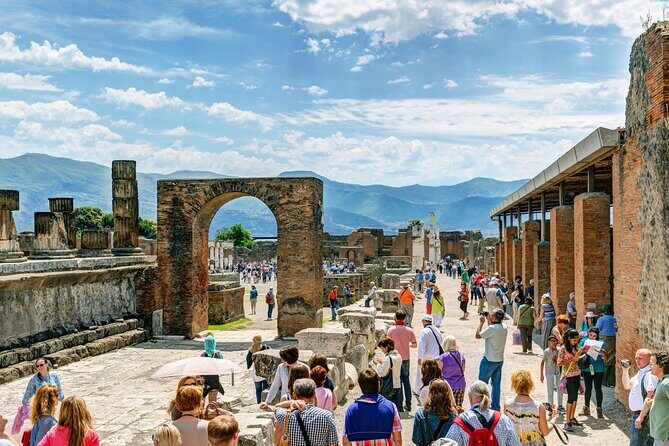
- Foro (Forum of Pompeii): politics, law, business, and worship
- Tempio di Giove Capitolino: Jupiter’s temple with Vesuvius behind it
- Macellum: the market that tells you what people ate and sold
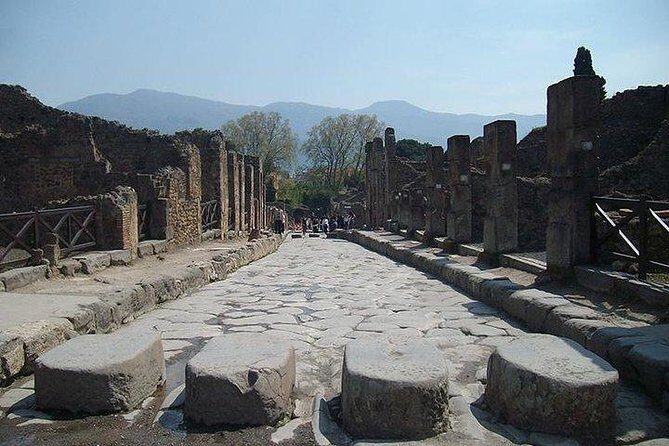
- Via dell’Abbondanza: the main street route from Forum to theatre
- Stabian Baths (Terme Stabiane): the most Roman-feeling stop on the day
- Lupanar: the brothel with erotic paintings
- Teatro Grande: comedies and tragedies with a dramatic view
- The winery lunch in the Vesuvius zone: food and wine, plus a time tradeoff
- What you’ll eat and drink
- Herculaneum: why it feels different from Pompeii
- House of the Deer: sea-view luxury and a house with a story
- Casa di Nettuno e Anfitrite: glass-paste mosaics you can actually see
- Casa dello Scheletro: the skeleton house name makes you look twice
- Sacello degli Augustali: frescoes near the forum
- House of the Hotel: big scale, plus a spa district
- Casa del Salone Nero: the black-painted party hall and the wax tablets
- Guides and pacing: what makes the difference on a long day
- Value and who this tour suits best
- Should you book this Pompeii and Herculaneum tour?
- FAQ
- How long is this Pompeii and Herculaneum tour?
- What sites are included in the day?
- Is the entry ticket included?
- Is lunch included?
- What language is the tour offered in?
- How many people are in the group?
- Do I need a printout ticket?
- Is the tour dependent on weather?
- What should I wear or bring for the day?
Key highlights you’ll feel right away
- Two archaeological sites, same day: Pompeii’s bigger city feel plus Herculaneum’s unusually preserved streets and houses.
- Forum to bath complex to theatre in Pompeii: you see politics, commerce, hygiene, and entertainment in sequence.
- Stabian Baths details that explain how Romans lived: frigidarium/tepidarium/calidarium, plus how heat traveled through pipes and floors.
- Herculaneum’s mosaics and special houses: from glass-paste mosaics (Neptune and Amphitrite) to the black-painted salon.
- Winery stop tied to the Vesuvius story: wine tasting and a local-food lunch, included in the day.
- Heat management depends on your guide: shade breaks can matter when summer temperatures are high.
Why this Pompeii and Herculaneum day tour is a smart use of time
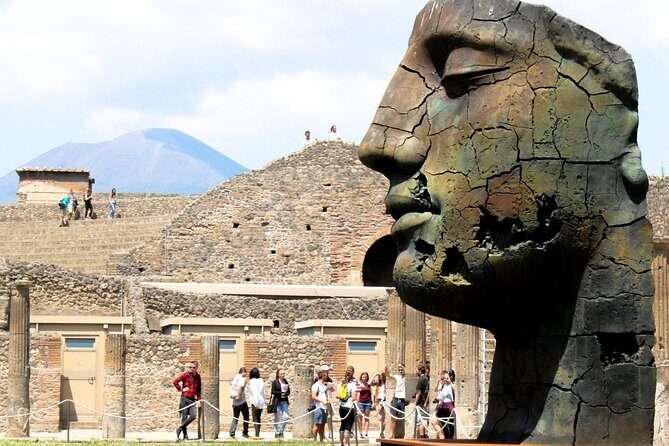
If you’re basing in Sorrento, this is one of the more practical ways to hit both ruins without turning your day into a DIY transportation puzzle. Pompeii and Herculaneum are far enough apart in experience (and pacing) that trying to “pick them yourself” often means juggling tickets, entry times, and guides.
You also get a real sense of contrast. Pompeii feels like a sprawling city you’re walking through in sections. Herculaneum feels more intimate—smaller, but famously well-preserved—so the houses and street layouts can read like you’re stepping into a moment frozen mid-day.
The group format helps too. With a max of 100 people, it’s not a solo mission, but it’s usually not a chaotic free-for-all either. You’re there for guided context, not just sightseeing.
You can also read our reviews of more tours and experiences in Sorrento


Pompeii: the streets and buildings you actually need to see
Pompeii starts strong because it’s huge. The trick on any first visit is prioritizing the places that explain how a Roman city worked—public life, daily commerce, and the “regular people” spaces.
Archaeological Park of Pompeii: more than ruins, it’s a city layout
You’ll begin at the Archaeological Park, where the streets and houses are laid out in a way that’s easy to follow with a guide. Pompeii was buried after the eruption of Mount Vesuvius in 79 AD, and what you walk through today is the result of excavations across a wide urban footprint.
What to expect: long stretches of walking and frequent stops where a guide ties a building to daily life.
Why it matters: the park isn’t just a few famous spots; it’s the context that makes later stops click.
A practical note: on very busy days, entry logistics and crowd density can slow movement. That’s outside the tour’s control, so plan to stay patient and let the guide do the sorting.
Foro (Forum of Pompeii): politics, law, business, and worship
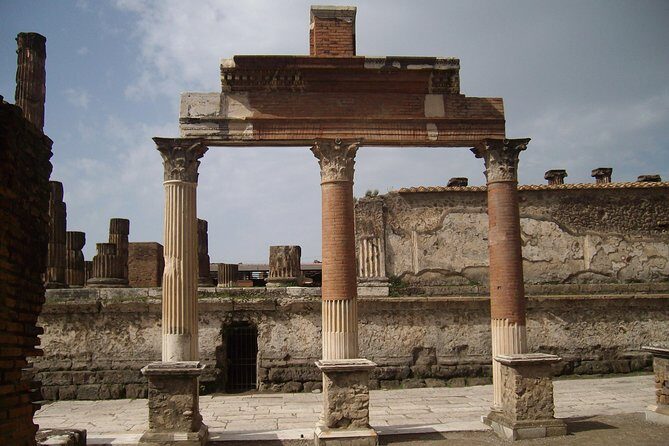
The Forum is the city’s public center—administration, justice, business activity, and civic worship all concentrated in one zone. Even without reading every label, you’ll get the logic: this is where people gathered, argued, traded, and made the city run.
You’ll also get good sightlines, because the Forum area includes dramatic backdrops, including Vesuvius rising behind key buildings.
Tempio di Giove Capitolino: Jupiter’s temple with Vesuvius behind it
On the northern side of the Forum, the Temple of Jupiter anchors the skyline. After the colony was established around 80 BC, the temple was renovated and became a Capitolium-style complex, linked to the cult statues of Jupiter, Juno, and Minerva.
The payoff for your photos: the combination of temple architecture and the mountain in the background is hard to beat.
The payoff for your understanding: this stop helps explain Roman religious authority as part of government life.
You can also read our reviews of more guided tours in Sorrento



Macellum: the market that tells you what people ate and sold
The Macellum was Pompeii’s market. You’ll see how commerce was designed with crowd flow in mind—porticoes, an elevated worship hall aligned with the entrance, and a layout that kept the main square from turning into a bottleneck.
What makes this stop feel real is the decorative storytelling. The portico walls included scenes from daily life like fish and poultry selling, alongside mythological subjects. Food, work, and belief were literally painted onto the spaces people used.
Via dell’Abbondanza: the main street route from Forum to theatre
Via dell’Abbondanza is one of Pompeii’s main arteries, linking the Forum to the Amphitheatre. Walking a section of it gives you a sense of how movement worked through the city.
If you’ve ever wondered whether Roman towns were designed more for pedestrians or movement between landmarks, this street segment helps answer it.
Stabian Baths (Terme Stabiane): the most Roman-feeling stop on the day
If you want one “how did they live?” stop in Pompeii, make it the Stabian Baths. These baths were built in phases, with the early phase dating back to the 4th century BC and major construction later. The complex you visit includes the courtyard, the pool, and a colonnade leading toward men’s quarters with rooms that lead from the apodyterium to the frigidarium, tepidarium, and calidarium.
Why I love this stop: it’s not just a pretty ruin. You see the system behind the comfort—heat piped through the walls and delivered via double floors that circulated hot air from furnaces and braziers. Even the women’s quarters followed a similar room sequence, just smaller and less decorated.
And yes, baths weren’t only for cleanliness. People discussed politics, battles, trials, and social matters there too. That’s what turns “bathrooms from 79 AD” into an actual social scene.
Lupanar: the brothel with erotic paintings
The Lupanar is one of Pompeii’s most famous buildings, and it’s not subtle. It functioned as a brothel with erotic paintings. The building layout is clear: two floors, with the owner and enslaved workers upstairs and rooms downstairs—each fitted with a built-in bed.
A guide’s tone matters here. The respectful value is in understanding how this space was organized and who worked there (often Greek and Oriental slaves, according to the information shared on-site). If you’re easily uncomfortable with adult subject matter, you may want to mentally brace yourself before this stop.
Teatro Grande: comedies and tragedies with a dramatic view
The Large Theatre (Teatro Grande) was built in the mid–2nd century BC and later restored in Roman style. Expect a setting for comedies and tragedies tied to Greek-Roman traditions.
One of the most interesting points is that it was the first large public building to be freed from eruption deposits during excavation efforts. That makes it a meaningful “survival marker” inside Pompeii’s broader destruction story.
Practical tip: theatres make people want to linger. If your group is moving, take the quick visual sweep now, then let your guide provide the context as you walk.
The winery lunch in the Vesuvius zone: food and wine, plus a time tradeoff
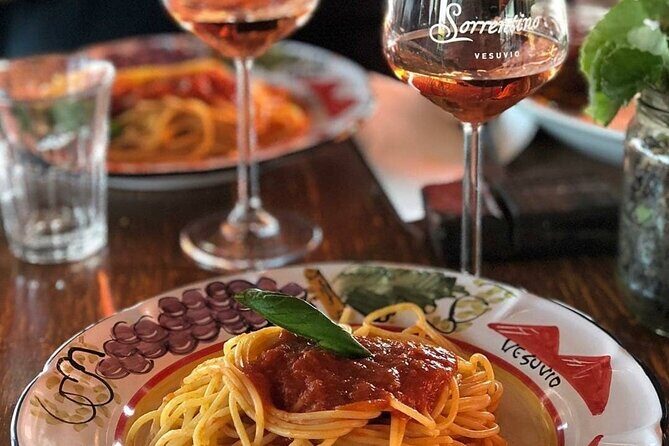
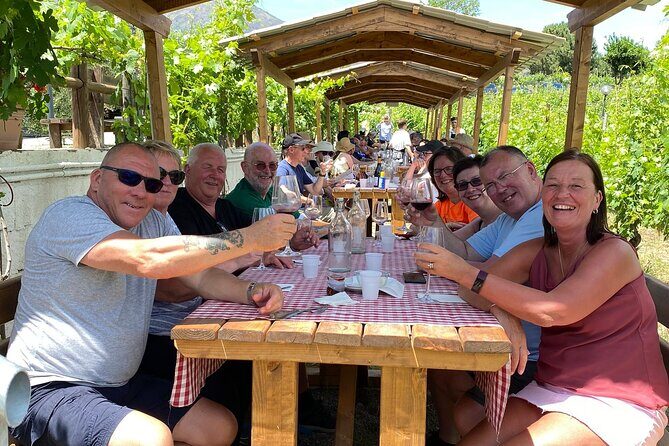
After Pompeii, the day shifts into lunch-mode at Sorrentino Vini, a winery founded in 1990 by Paolo Sorrentino. The estate is tied to the Vesuvius National Park and includes 35 hectares of property, with Lacryma Christi highlighted as the well-known Vesuvius wine.
This stop is where you get the food you actually need for a full day of ruins.
What you’ll eat and drink
Lunch includes a starter of bruschetta, cured meats, cheeses, and seasonal vegetables. You also get a tasting of three wines: Prosecco, Red, and White. The main course is pasta with piennolo cherry tomatoes, followed by a traditional homemade dessert.
Why this stop works (even if you’re not a wine person): it breaks up the pacing. Without this reset, doing Pompeii then immediately pushing into Herculaneum would feel relentless.
Tradeoff: this is also time you could spend walking ruins. If your ideal day is pure archaeology and zero breaks, know that lunch here is part of the day design, not a side quest.
Herculaneum: why it feels different from Pompeii
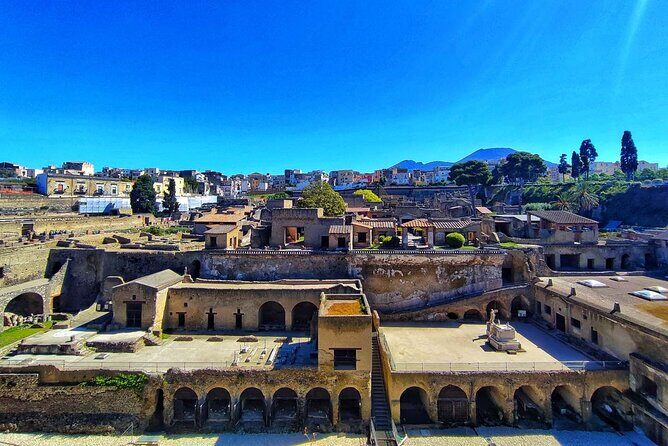
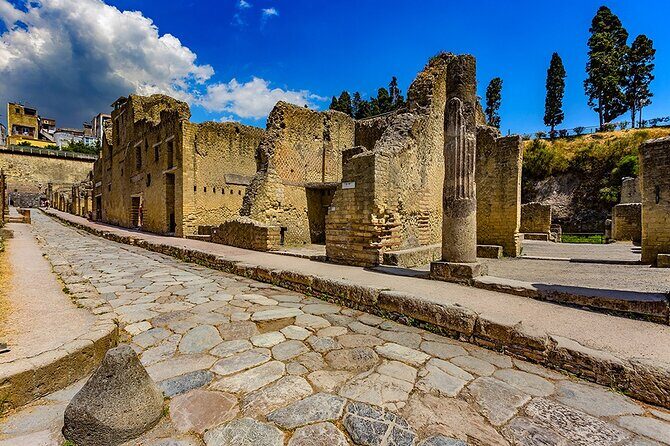
Herculaneum is the second act, and it changes the texture of your visit. It was a smaller Roman city, also buried in 79 AD, but the site is still considered unusually well-preserved. That matters because houses and street structures are easier to “read” as lived-in spaces.
The whole vibe is more detailed because you can recognize how rooms and entrances function. You’ll spend about two hours here, which is long enough to make the main impressions stick.
House of the Deer: sea-view luxury and a house with a story
The House of the Deer belonged to Q. Granius Verus, a slave freed shortly before the destruction. The terrace offers a sea-view setting, and in the garden there are two statues of deer attacked by a pack of dogs—the reason this home carries its name.
Why this stop is worth it: it’s a reminder that Herculaneum wasn’t just ancient ruins; it was a place where freed people built lives that included art and leisure.
Casa di Nettuno e Anfitrite: glass-paste mosaics you can actually see
This house is famous for its mosaics made with glass paste—expensive materials for the time. Expect floral and hunting scenes, plus a central mosaic showing Neptune and Amphitrite.
How to appreciate it in a group: pause for the main central image first. Then let your guide point out what surrounds it. It’s the layout that makes the artwork feel like it has meaning, not just decoration.
Casa dello Scheletro: the skeleton house name makes you look twice
The Casa dello Scheletro got its name from the discovery of human remains in a second-floor room in 1831. The house is often compelling because the name forces you to think about the people behind the destruction, not only the building design.
Sacello degli Augustali: frescoes near the forum
The Sacellum of the Augustales is a quadrangular building built near the forum area while Augustus was still alive and in power. It’s known for splendid frescoes depicting Hercules entering Olympus with Jupiter, Juno, Minerva, and Hercules against Achelous.
This is also where a janitor’s skeleton was found in his room lying on the bed—another detail that can hit hard because it connects a physical space to a specific human life.
House of the Hotel: big scale, plus a spa district
The House of the Hotel is enormous—2,250 square meters—and it sits on the edge of the hill in a panoramic position. It’s also notable because it’s the only home in Herculaneum known to have a spa district, which is why it was once thought of as a hotel.
Even if you don’t focus on measurements, you’ll feel the scale as you move through the remains.
Casa del Salone Nero: the black-painted party hall and the wax tablets
One of my favorite visual moments in this part of the day is the House of the Black Salon. The party hall is painted entirely black with geometric patterns, which gives it a stark, memorable look.
In this house, waxed tablets of L. Venidius Ennychus were found. The tablets relate to eligibility for Augustale, the purchase of a slave, and the birth of a daughter. If you like your archaeology grounded in real documents, this is the stop where that idea becomes tangible.
Guides and pacing: what makes the difference on a long day
On a day this packed, the guide can make or break the experience. In past days, people have highlighted how guides like Celsestina and Diana didn’t just recite facts—they explained daily life and then pointed out the differences between Pompeii and Herculaneum so the day made sense as a pair.
I’d treat shade and comfort as part of your strategy. In summer, the ruins can feel hot and exposed. If your guide is paying attention, you’ll get help finding cooler spots to hear key explanations.
Also, if you’re traveling with the mindset of learning fast, you’ll do great. If you prefer to wander with zero structure, this tour’s format may feel tight.
Value and who this tour suits best
At $192.22 per person for a roughly nine-hour day, you’re paying for three big things at once: guided interpretation, admission tickets included across both sites, and a winery lunch with wine tasting. The day isn’t cheap, but it’s not random either.
This is especially good if:
- you want one organized full-day plan from Sorrento
- you’re seeing Pompeii and Herculaneum for the first time
- you prefer a guide to help you understand what you’re looking at (Forum, baths, markets, mosaics, and the private homes)
It’s less ideal if:
- you dislike structured timing and prefer unguided wandering
- you need long quiet breaks every hour
- you’re extremely sensitive to adult-themed material (the Lupanar)
Should you book this Pompeii and Herculaneum tour?
I’d book it if your main goal is maximum Roman-ruins impact in one day with fewer logistics headaches. The biggest strength is the combination: Pompeii’s public-city story, then Herculaneum’s unusually preserved houses and artworks, with real food and wine waiting in the middle.
Before you click, check two practical things. First, go in expecting crowds and heat at Pompeii—your guide can help, but the site is popular. Second, accept that lunch and structured timing are part of the design. If that fits your travel style, this tour is a strong value for a first-time visit.
FAQ
How long is this Pompeii and Herculaneum tour?
It runs about 9 hours.
What sites are included in the day?
You visit Pompeii (including the Archaeological Park, Forum areas, and multiple landmarks) and Herculaneum (including several notable houses and a chapel).
Is the entry ticket included?
Yes. Admission tickets are included for the Pompeii and Herculaneum stops listed, and some specific houses are marked as free within the tour route.
Is lunch included?
Yes. Lunch is included at a winery, along with a tasting of three wines.
What language is the tour offered in?
The tour is offered in English, and it may be operated by a multilingual guide.
How many people are in the group?
The maximum group size is 100 travelers.
Do I need a printout ticket?
No. You’ll use a mobile ticket.
Is the tour dependent on weather?
Yes. The experience requires good weather, and if canceled for poor weather you’ll be offered a different date or a full refund.
What should I wear or bring for the day?
Wear comfortable shoes, and bring sunglasses and sunscreen, especially in summer.

More Tickets in Sorrento

More Tours in Sorrento




More Tour Reviews in Sorrento
- Sorrento Farm and Food Experience including Olive Oil, Limoncello, Wine tasting
★ 5.0 · 2,524 reviews